
Artificial Intelligence is moving quickly from experimentation to enterprise priority.
Organizations are building AI proofs of concept around conversational analytics, copilots, intelligent search, automation, AI agents, and other emerging capabilities.
Many of those POCs work.
Then comes the harder question:
How do we scale this across the enterprise?
That’s where many organizations discover the challenge isn’t necessarily the AI.
It’s the data foundation underneath it.
The AI POC Is the Easy Part
AI proofs of concept are intentionally designed to move quickly.
They typically involve a focused use case, limited data, controlled access, and clearly defined outcomes.
That makes it possible to demonstrate value quickly.
But moving from a successful POC to enterprise production introduces an entirely different level of complexity.
AI may now need to interact with data across ERP, CRM, financial systems, operational applications, customer information, documents, third-party platforms, and historical data.
Suddenly, the challenge is no longer simply whether the AI works.
The question becomes:
Is the enterprise data environment ready to support it?
Scaling AI Exposes Existing Data Problems
AI doesn’t automatically fix fragmented or inconsistent data.
In many cases, it exposes it.
As AI begins interacting with enterprise information, organizations quickly encounter questions such as:
✅ Which system contains the authoritative data?
✅ Which version of a KPI is correct?
✅ How current is the information?
✅ Who owns the data?
✅ Who should have access to it?
✅ Can an answer be traced back to its source?
✅ Can users trust the answer?
These aren’t primarily AI problems.
They are data architecture, integration, governance, security, quality, and business logic problems.
AI Is Only as Good as the Foundation Underneath It
Imagine asking an enterprise AI assistant:
“What was our revenue last quarter?”
The question sounds simple.
But what if Finance and Operations calculate revenue differently?
What if different reports contain different business rules?
What if the required information exists across multiple systems?
What if some of the underlying data hasn’t been updated?
The AI still needs to determine what information represents the trusted enterprise answer.
Without a governed data foundation, AI can provide an extremely convincing answer that may still be wrong.
And as AI moves into business-critical processes, that becomes a much bigger problem.
AI Needs More Than Data. It Needs Business Context.
Giving AI access to more data isn’t enough.
AI also needs to understand what that data means to the business.
Consider another seemingly simple question:
“Which locations are underperforming?”
Underperforming based on what?
Revenue? Margin? Volume? Growth? Budget variance? Operational efficiency?
Organizations already struggle with inconsistent business definitions across dashboards, spreadsheets, applications, and departments.
AI inherits those same inconsistencies.
This is why governed business definitions, semantic models, metadata, and standardized KPIs become increasingly important.
The objective is to create a common business language that can be used consistently across:
✅ Reporting
✅ Analytics
✅ Automation
✅ Applications
✅ AI
The Five Building Blocks for Scaling Enterprise AI
Moving beyond AI POCs requires a foundation capable of supporting AI in production.
1. Integrated Enterprise Data
Enterprise data needs to be connected across applications, platforms, and business functions.
AI becomes significantly more valuable when it can securely interact with information across the organization instead of operating within isolated data silos.
2. Trusted Data
AI requires accurate, validated, and current information.
Data quality issues that once created reporting problems can quickly become AI reliability problems.
If users cannot trust the answers, adoption disappears.
3. Governed Business Definitions
Organizations need consistent definitions for critical business metrics and entities.
Revenue should mean the same thing whether it is being consumed by a dashboard, executive report, application, or AI assistant.
4. Governance and Security
Enterprise AI must operate within enterprise controls.
That includes:
✅ Identity and access management
✅ Data ownership
✅ Metadata and lineage
✅ Sensitive data protection
✅ Role-based security
✅ Auditability
AI should not create another uncontrolled path into enterprise information.
5. A Modern Data Platform
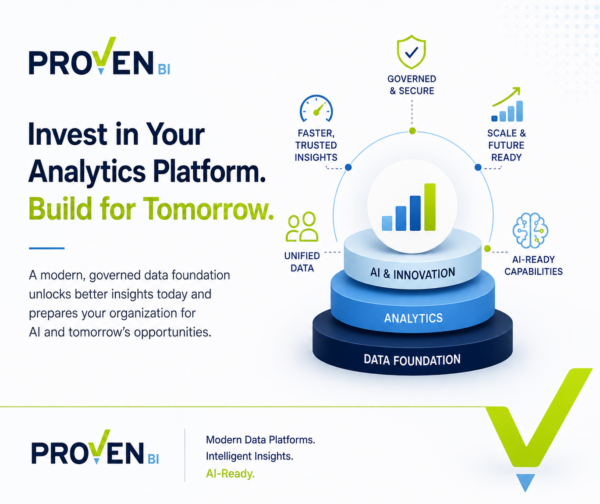
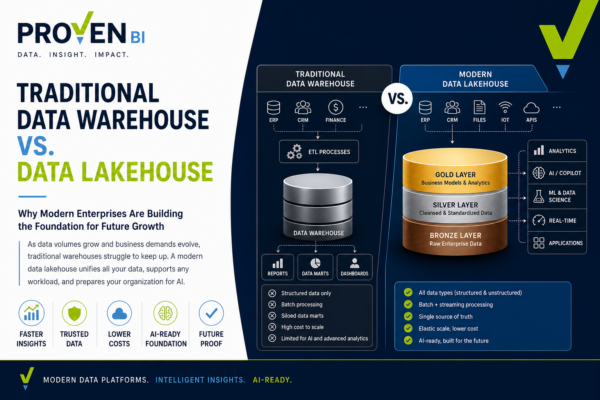
Organizations need an architecture capable of supporting analytics, automation, and AI from a shared foundation.
A modern data platform provides the ability to integrate, govern, secure, model, and activate enterprise data across multiple workloads.
Instead of creating a new data architecture for every AI project, organizations can build reusable capabilities that support what comes next.
Build the Foundation Once. Use It Many Times.
Without a shared data foundation, scaling AI can quickly become:
New AI Use Case → New Integration → New Data Preparation → New Security Model → New Governance Problem
That approach becomes increasingly difficult to maintain as AI adoption grows.
A modern data architecture creates a different model:
Enterprise Data → Trusted Data Foundation → Analytics + Automation + AI
The same trusted foundation can support:
✅ Reporting
✅ Analytics
✅ Applications
✅ Automation
✅ Data Science
✅ AI
Instead of solving the same underlying data problems for every new initiative, the organization creates reusable enterprise capabilities.
Don’t Stop Experimenting With AI
None of this means organizations should stop building AI POCs.
Experimentation is important.
AI POCs help organizations identify high-value opportunities, demonstrate what is possible, and determine where AI can create measurable business value.
But there is an important distinction.
The POC answers:
Can AI create value here?
The data foundation answers:
Can we deliver that value securely, consistently, and at scale?
Successful AI strategies need both.
Organizations shouldn’t wait until their data environment is perfect before experimenting with AI.
Instead, AI experimentation and data modernization should work together.
AI Readiness Starts With the Data Foundation
AI technology will continue to evolve rapidly.
Models will improve. Agents will become more capable. New tools and platforms will continue to emerge.
But one requirement isn’t going away:
AI needs trusted data and business context.
The organizations that successfully move beyond AI proofs of concept won’t simply be those with access to advanced AI technology.
They will be the organizations that have built the trusted, governed, secure, and scalable data foundation required to operationalize it.
Because moving from an AI POC to enterprise AI doesn’t start with a better model.
It starts with a better data foundation.
How ProvenBI Helps
At ProvenBI, we help organizations architect and build modern data platforms designed to move analytics and AI beyond experimentation and into production.
Our approach focuses on:
✅ Unifying fragmented enterprise data
✅ Modernizing data architecture
✅ Establishing governance and security
✅ Creating trusted business definitions
✅ Building scalable analytics foundations
✅ Preparing enterprise data for AI
The goal isn’t to build a data platform for one AI use case.
It’s to create a modern, reusable data foundation capable of supporting analytics, automation, applications, and AI as the business evolves.
Modern Data Platforms. Intelligent Insights. AI-Ready.
Ready to Modernize?
LET’S TALK
Let’s build a modern data platform that creates the trusted foundation your organization needs to scale analytics and AI.