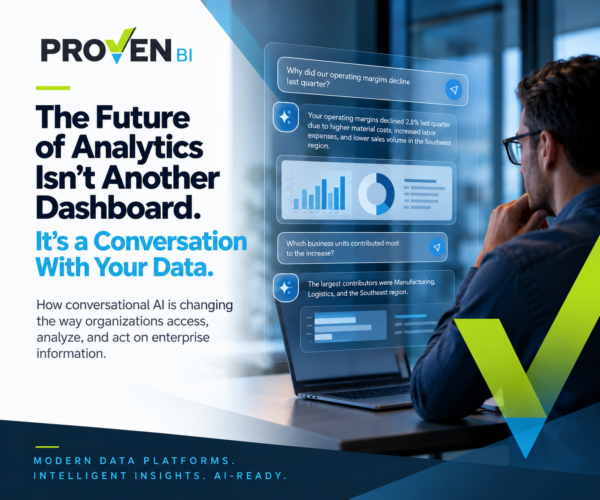
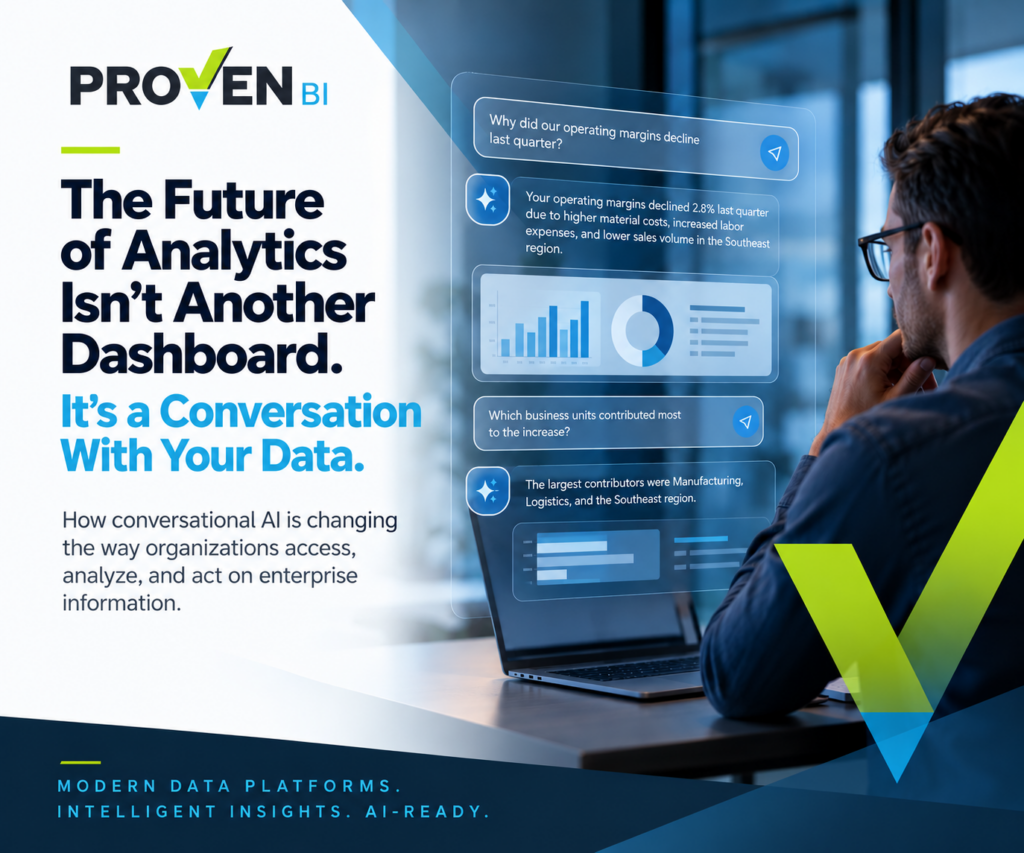
How conversational AI is changing the way organizations access, analyze, and act on enterprise information.
For years, organizations have invested heavily in business intelligence platforms, dashboards, and reporting tools to better understand their operations.
And for good reason.
These technologies have helped businesses improve visibility, track performance, and make more informed decisions.
But as organizations generate more data and business questions become increasingly complex, a fundamental limitation is becoming clear.
Dashboards are great at showing you what happened. But what happens when you need to understand why?
That’s where the next evolution of enterprise analytics begins.
The future isn’t about building more dashboards. It’s about giving business users the ability to have meaningful conversations with their data.
The Problem With Traditional Business Intelligence
Most organizations today have no shortage of reports or dashboards.
Finance teams have financial dashboards. Sales teams have pipeline reports. Operations teams track performance metrics. Executives have scorecards measuring everything from revenue to operational efficiency.
But despite these investments, accessing the right information can still be surprisingly difficult.
Consider a common scenario.
A CFO opens a dashboard and notices that operating expenses increased significantly during the previous quarter.
The dashboard shows the increase, but it doesn’t explain what’s driving it.
The CFO wants to know:
- Which business units contributed most to the increase?
- Were the additional expenses related to labor, materials, or operational inefficiencies?
- How does this compare to the same period last year?
- Which areas present the greatest opportunities for cost reduction?
Answering these questions may require additional reports, manual analysis, or assistance from the IT and analytics teams.
What started as a simple business question becomes a multi-step process.
The problem isn’t necessarily the dashboard. It’s that traditional reporting often limits users to questions someone anticipated when the dashboard was built.
Enter Conversational AI for Enterprise Analytics
Conversational AI introduces a fundamentally different way for organizations to interact with their information.
Instead of navigating multiple dashboards, applying filters, or requesting new reports, business users can ask questions using natural language.
Imagine an executive typing:
“Why did our operating margins decline last quarter?”
A conversational analytics solution connected to trusted enterprise data could analyze relevant financial and operational information and provide an explanation of the primary contributing factors.
The executive could then continue the conversation:
“Which business units experienced the largest decline?”
Followed by:
“Compare those results to the previous four quarters.”
And finally:
“Show me the locations where we have the greatest opportunity to improve profitability.”
Rather than starting a new reporting process with every question, users can progressively explore their information.
This is where analytics begins to move beyond static reporting toward a more interactive, accessible experience.
Five Ways Conversational AI Can Transform Enterprise Analytics
1. Making Data More Accessible Across the Organization
Historically, advanced data analysis has required familiarity with reporting tools, SQL, data models, or specialized analytics applications.
Conversational AI can lower that barrier.
Business users can ask questions in familiar language without needing to understand the underlying technical architecture.
This creates opportunities for more employees to make informed decisions using enterprise data.
2. Accelerating the Decision-Making Process
Business decisions often depend on how quickly organizations can access and interpret information.
When executives must wait for reports to be developed or modified, valuable time can be lost.
Conversational analytics can reduce that dependency by allowing users to explore approved enterprise information directly.
The result is a more responsive approach to business intelligence.
3. Moving From What Happened to Why It Happened
Traditional dashboards excel at presenting predefined KPIs and performance trends.
Conversational AI can help users investigate those results further.
For example, a sales leader might ask:
“Why did revenue decline in the Southeast region?”
The next question might be:
“Was the decline driven by fewer customers, lower transaction volumes, or changes in pricing?”
With the appropriate data and analytical capabilities, users can explore potential drivers rather than stopping at a high-level metric.
4. Reducing the Reporting Burden on IT and Analytics Teams
In many organizations, analytics teams spend significant time responding to recurring business questions and creating variations of existing reports.
Conversational AI can help automate access to common analytical questions.
This allows technical teams to focus more attention on data engineering, governance, advanced analytics, and strategic initiatives.
Rather than serving as the primary gatekeepers of information, they can focus on making enterprise data more valuable.
5. Creating a Foundation for More Advanced AI Capabilities
Conversational analytics is also an important step toward broader enterprise AI adoption.
Once organizations establish trusted, governed data and accessible analytical capabilities, they can begin exploring additional use cases involving predictive analytics, intelligent automation, and AI agents.
Conversational AI can become an interface through which employees interact with these capabilities.
The Critical Component: A Modern Data Foundation
While conversational AI creates exciting possibilities, there’s an important reality organizations cannot overlook.
AI is only as reliable as the data and business context supporting it.
Connecting a large language model to disconnected databases and inconsistent reporting environments does not automatically create trustworthy analytics.
In fact, it can introduce additional risks.
If financial metrics are calculated differently across departments, an AI solution may return inconsistent answers.
If data is incomplete or outdated, the insights may be misleading.
If security and governance are not properly implemented, sensitive enterprise information could be exposed to unauthorized users.
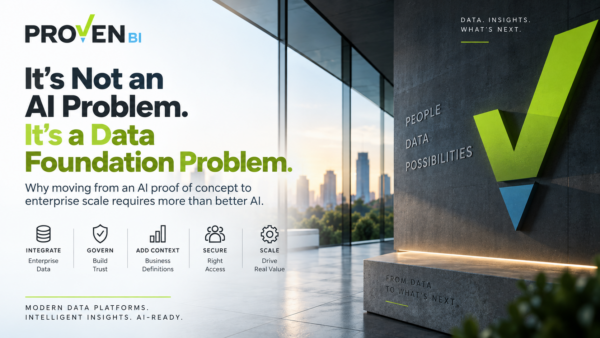
That’s why successful conversational analytics requires more than selecting an AI technology.
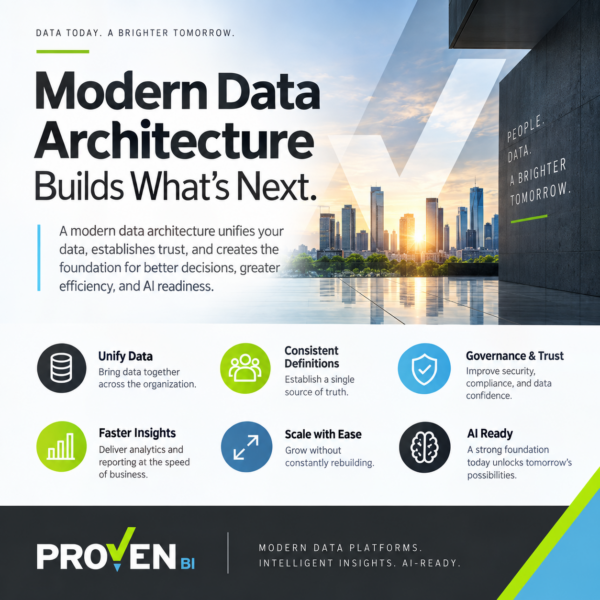
It requires a modern enterprise data foundation built around several critical capabilities.
Data Integration: Bringing together information from ERP, CRM, financial, operational, and other enterprise systems.
Data Quality and Governance: Establishing trusted information, consistent definitions, and appropriate controls.
Semantic Models: Creating a common business language so metrics such as revenue, profitability, customer retention, and operational performance are calculated consistently.
Security and Access Management: Ensuring users can access only the information they are authorized to see.
Scalable Data Architecture: Building an environment capable of supporting growing analytical workloads and emerging AI applications.
AI Grounding and Validation: Connecting AI responses to approved enterprise data, validating generated queries and calculations, and providing traceability so users can understand where answers originated.
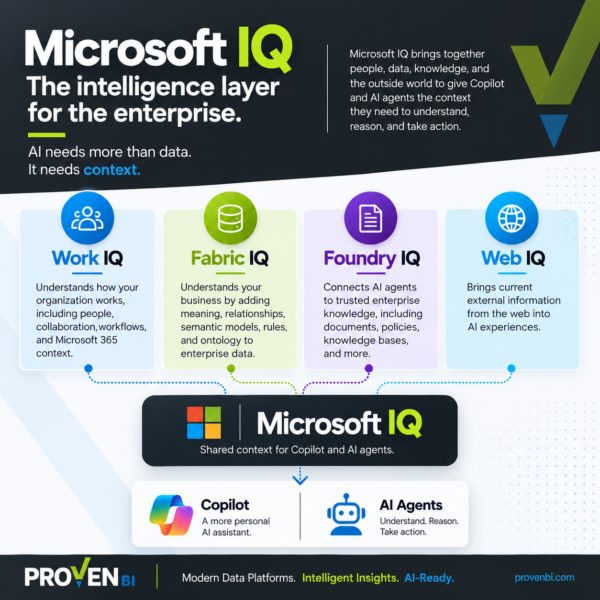
Technologies such as Microsoft Fabric, Azure, and Databricks can play important roles in supporting these capabilities.
However, the technology itself is only part of the equation.
The real objective is creating an environment where business users can confidently access and interact with trusted enterprise information.
Does Conversational AI Replace Dashboards?
Not necessarily.
Dashboards will continue to play an important role in enterprise analytics.
They provide an efficient way to monitor KPIs, identify trends, track operational performance, and communicate information visually.
Conversational AI complements these capabilities by allowing users to explore questions that extend beyond predefined reports.
Think about the difference:
| Traditional Dashboards | Conversational Analytics |
|---|---|
| Displays predefined KPIs | Answers dynamic business questions |
| Requires navigation and filters | Uses natural language |
| Focuses on monitoring performance | Supports interactive exploration |
| Often requires new reports for new questions | Enables follow-up questions |
| Presents established views of data | Helps users investigate underlying drivers |
The strongest enterprise analytics strategies will combine both approaches.
Dashboards help organizations monitor their business. Conversational AI helps them explore and better understand it.
What This Means for Business Leaders
For CIOs, CTOs, CFOs, and data leaders, conversational AI represents an opportunity to rethink how enterprise information is delivered.
The conversation should no longer focus exclusively on how many dashboards an organization needs.
Instead, leaders should be asking:
- How easily can our employees access trusted business information?
- How much time do we spend manually preparing and reconciling reports?
- Can our teams investigate business performance without constantly relying on technical resources?
- Are our data platforms and governance processes ready to support AI?
- How can we make analytics more accessible while maintaining security and consistency?
These questions shift the focus from reporting technology to business outcomes.
And that’s where meaningful transformation happens.
How ProvenBI Helps Organizations Prepare for the Next Generation of Analytics
At ProvenBI, we believe the future of enterprise analytics begins with a modern, trusted data foundation.
We help organizations connect and modernize their data environments, establish consistent business metrics, and create scalable platforms that support traditional business intelligence, advanced analytics, and AI.
Our approach focuses on bringing together the critical components of an intelligent enterprise data environment:
- Modern data platform architecture and implementation
- Enterprise data integration and engineering
- Data warehousing and lakehouse solutions
- Data governance and semantic modeling
- Business intelligence and analytics
- Conversational AI and AI-ready data architectures
By connecting these capabilities, organizations can move beyond disconnected reporting environments and begin creating more accessible, intelligent ways to interact with their information.
The Future of Analytics Is a Conversation
Organizations have spent years building dashboards to help employees understand their businesses.
The next evolution is giving those employees the ability to ask questions, investigate results, and discover insights through natural conversations with trusted enterprise data.
It’s not about eliminating dashboards.
It’s about making analytics more accessible, more interactive, and ultimately more valuable.
The future of analytics isn’t another dashboard. It’s the ability to have a conversation with your data.
Is Your Data Platform Ready for What’s Next?
If your organization is exploring conversational AI, modern analytics, or enterprise data modernization, ProvenBI can help you evaluate your current environment and develop a strategy for moving forward.
Let’s discuss how to turn your enterprise data into a foundation for intelligent insights and AI.
Modern Data Platforms. Intelligent Insights. AI-Ready.