Artificial intelligence is quickly becoming part of the enterprise technology roadmap. Organizations are exploring Generative AI, Copilot, AI agents, predictive analytics, conversational AI, and automation to improve how they operate and make decisions.
But there is an important reality that often gets overlooked:
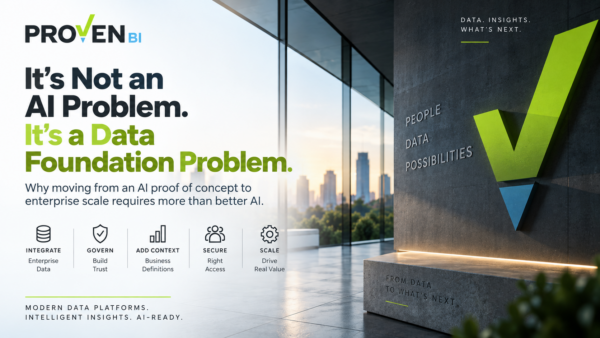
AI readiness doesn’t start with AI. It starts with your data foundation.
Before organizations can effectively scale AI and advanced analytics, they need an environment where data is connected, trusted, governed, accessible, and designed to support what comes next.
The organizations that invest in that foundation today will be better positioned to take advantage of AI tomorrow.
Start With the Data Foundation
Most organizations already have plenty of data.
The challenge is that it often lives across ERP systems, CRM platforms, operational applications, cloud environments, spreadsheets, third-party platforms, and legacy databases.
Over time, this creates a fragmented environment where:
- Data exists in silos
- Business definitions vary across departments
- Reporting logic is embedded in individual dashboards
- Data pipelines become difficult to maintain
- Users question which numbers they can trust
- Governance and ownership are unclear
- Accessing information requires significant manual effort
Adding AI on top of this environment doesn’t eliminate these problems. In many cases, it exposes them.
If AI is going to become a trusted part of the organization, the underlying data must first become trusted.
Build a Modern, Scalable Data Platform
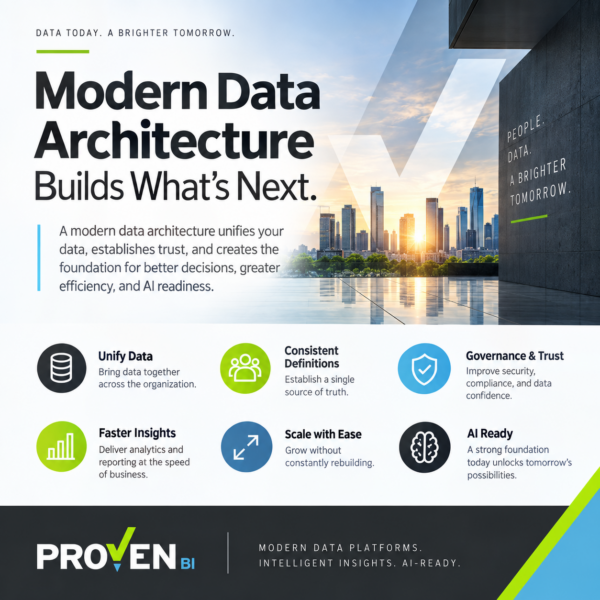
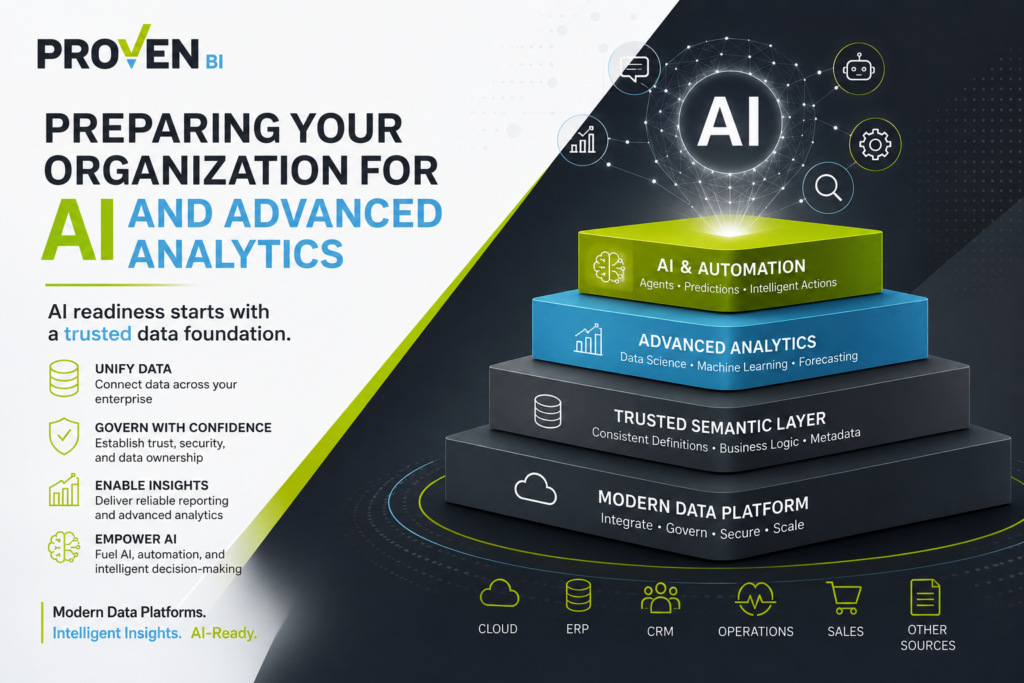
A modern data platform provides the architecture needed to bring enterprise data together and make it available for reporting, analytics, automation, and AI.
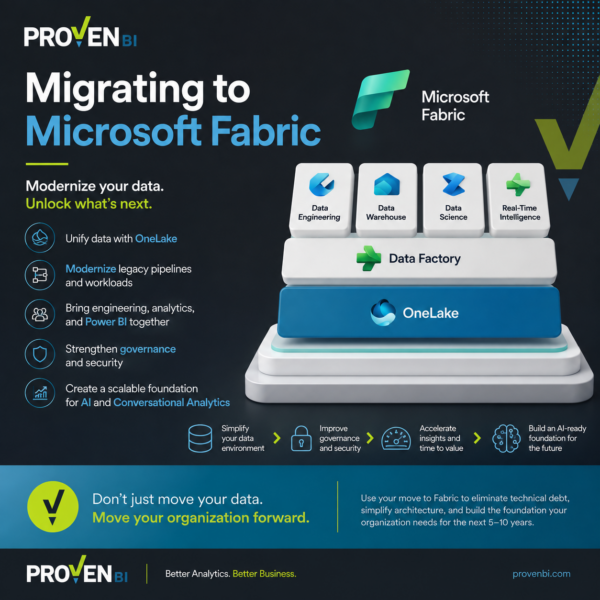
Platforms such as Microsoft Fabric, Azure, and Databricks allow organizations to move beyond disconnected databases and point-to-point integrations toward a more unified architecture.
A well-designed modern data platform should provide:
Unified Data
Bring financial, operational, customer, clinical, sales, marketing, and other enterprise data together into a common foundation.
Scalable Architecture
Design the environment to support increasing data volumes, new data sources, advanced analytics, and AI workloads without constantly rebuilding the architecture.
Trusted Data
Establish repeatable ingestion, transformation, validation, and quality processes so users and applications can rely on the information being provided.
Accessible Data
Make governed information available to Power BI, analytics applications, data science teams, AI models, agents, and other business applications.
The objective isn’t simply to build another data warehouse.
It’s to create a reusable enterprise data foundation.
Make Governance Part of the Architecture
As organizations expand their use of AI, data governance becomes even more important.
AI applications can dramatically increase the number of people and systems interacting with enterprise information. Organizations need to understand what data exists, where it originated, who owns it, how it should be used, and who should have access to it.
That means governance should include areas such as:
- Data ownership and stewardship
- Business definitions and metadata
- Data lineage
- Security and access controls
- Data quality standards
- Master data management
- Privacy and compliance
- AI governance and responsible data usage
Governance shouldn’t be something added after the platform has been built.
It should be designed into the foundation from the beginning.
Create a Trusted Semantic Layer
One of the biggest challenges organizations face isn’t collecting data. It’s agreeing on what the data means.
Revenue, customer, margin, utilization, conversion, patient, product, and other important metrics can have different definitions across departments and applications.
That becomes especially problematic when AI enters the environment.
If an executive asks an AI assistant, “What caused our margin to decline last quarter?” the organization needs confidence that the AI is working from the same governed definitions used by finance and leadership.
Creating standardized business logic and governed semantic models helps establish a common language across dashboards, analytics, applications, and AI.
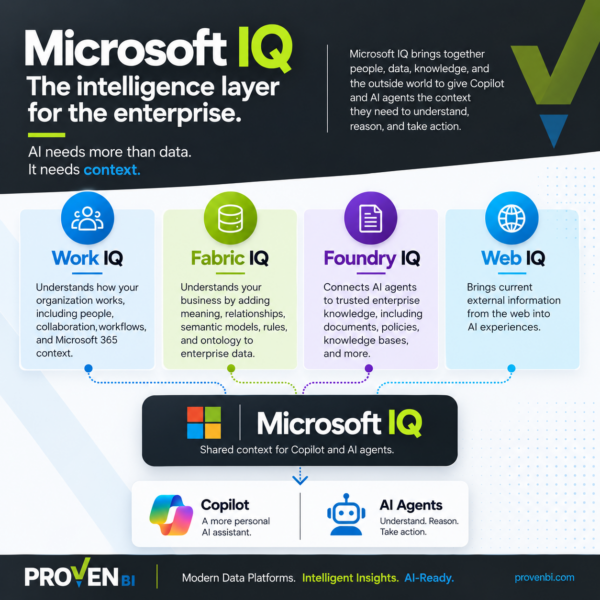
Instead of AI searching across disconnected information, it can interact with a trusted business data layer.
Move Beyond Dashboards
Dashboards and reporting will remain important, but the way users interact with enterprise data is changing.
Traditionally, a business user might open a dashboard, apply filters, analyze several reports, export information to Excel, and manually investigate the results.
AI creates an opportunity for a different experience.
Users may increasingly ask questions such as:
“Why did revenue decline last month?”
“Which customers have the highest risk of churn?”
“Which locations are underperforming against budget?”
“What are the biggest operational issues affecting margin?”
“Summarize our performance and identify the three areas requiring my attention.”
This is where conversational AI, AI agents, predictive analytics, and intelligent automation become powerful.
But these capabilities are only as reliable as the data architecture behind them.
Prepare Your Data for AI Agents
The next evolution of enterprise AI will increasingly involve agents capable of performing tasks, analyzing information, identifying issues, and assisting users with decisions.
For example, an AI agent could potentially:
- Monitor operational KPIs
- Identify anomalies
- Investigate contributing factors
- Summarize findings
- Recommend actions
- Trigger workflows
- Notify appropriate stakeholders
That requires more than connecting an AI model to a database.
Agents need governed access to trusted enterprise information, consistent business definitions, appropriate security controls, and clearly designed processes.
Organizations should begin thinking about their data platform not only as infrastructure for reporting, but as the information foundation for future AI applications and agents.
Think in Terms of a Data Hierarchy of Needs
Organizations don’t have to implement every advanced AI capability immediately.
A practical approach is to build capabilities in layers.
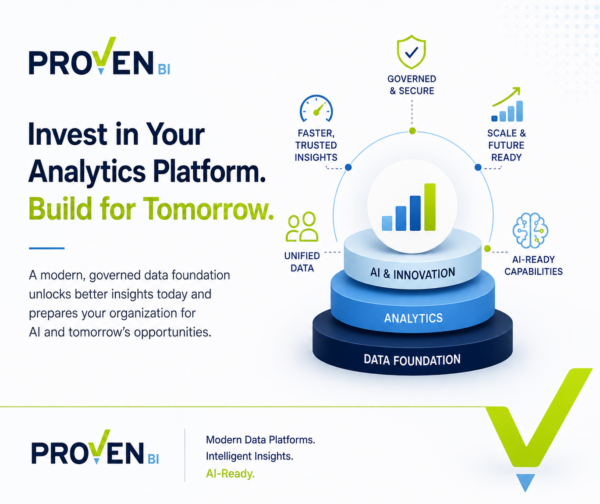
Foundation → Analytics → Automation → AI
First, establish the architecture, integration, governance, security, and trusted data foundation.
Then improve reporting, business intelligence, and advanced analytics.
Next, automate repeatable processes and decisions where appropriate.
Finally, introduce AI, conversational experiences, and agents on top of a foundation the organization can trust.
Trying to skip the foundation often results in impressive demonstrations that are difficult to scale into reliable enterprise solutions.
Start Preparing Now
AI technology will continue to evolve rapidly. Organizations don’t need to predict exactly which AI tools they will be using three years from now.
They do need an architecture capable of supporting them.
That means asking questions today such as:
- Can we easily integrate data from across the organization?
- Do we trust the quality of our data?
- Are our business definitions standardized?
- Do we understand data ownership and lineage?
- Is our architecture scalable?
- Can analytics and AI securely access governed enterprise data?
- Can we add new data sources without redesigning everything?
- Are we building a foundation that supports both today’s reporting needs and tomorrow’s AI use cases?
Organizations that can confidently answer these questions will be in a much stronger position as AI becomes increasingly embedded in everyday business operations.
Build for What’s Next
The goal of data modernization isn’t simply to create better dashboards.
It’s to create an enterprise information foundation capable of supporting better decisions, advanced analytics, automation, conversational experiences, and AI.
At ProvenBI, we help organizations design and build modern, governed, AI-ready data platforms across Microsoft Fabric, Azure, Databricks, and modern analytics technologies.
Our approach focuses on getting the foundation right first: architecture, integration, governance, security, data quality, and scalable analytics.
Because the organizations that get the data foundation right will be the organizations best positioned to take advantage of what AI makes possible.
Modern Data Platforms. Intelligent Insights. AI-Ready.