Artificial intelligence is rapidly becoming a strategic priority for organizations across nearly every industry. From generative AI and intelligent automation to predictive analytics and AI agents, businesses are exploring new ways to improve efficiency, accelerate decision-making, and create competitive advantages.
However, as organizations move beyond AI experimentation and begin deploying solutions across the enterprise, a critical challenge is emerging.
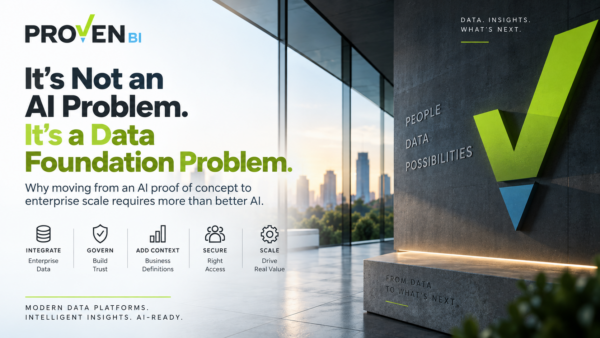
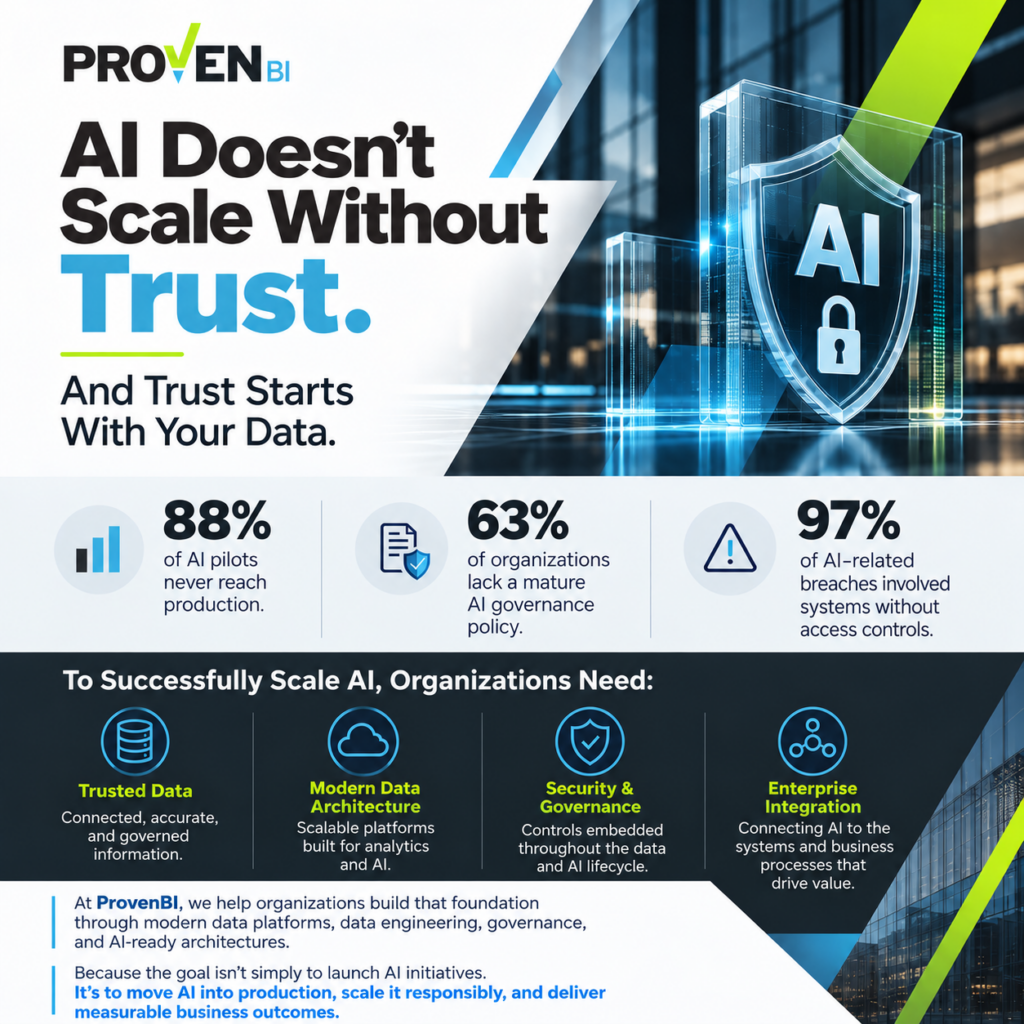
AI doesn’t scale without trust. And trust starts with your data.
Organizations can invest in sophisticated AI models, powerful cloud platforms, and advanced automation technologies, but without a reliable data foundation, those investments may struggle to deliver sustainable business value.
The organizations that successfully scale AI will be those that prioritize trusted data, modern architecture, governance, and enterprise integration.
The Growing Challenge of Scaling AI
AI adoption is accelerating, but moving from experimentation to enterprise-wide implementation remains difficult.
Many organizations have launched AI pilots, tested generative AI capabilities, and explored opportunities to automate business processes. Yet translating those initiatives into scalable, production-ready solutions requires more than selecting the right technology.
Common challenges include:
- Data scattered across disconnected systems and applications.
- Inconsistent business definitions and reporting metrics.
- Limited visibility into data quality and lineage.
- Security and governance policies that have not evolved with AI adoption.
- Legacy architectures that struggle to support modern analytics and AI workloads.
- Difficulty integrating AI capabilities into existing business processes.
These challenges often become more significant as organizations attempt to expand AI initiatives across departments, applications, and operational environments.
The problem isn’t necessarily the AI technology itself. It’s the foundation supporting it.
Without addressing these underlying challenges, organizations risk creating isolated AI solutions that are difficult to govern, maintain, and scale.
Trust Begins With Your Data Foundation
Every AI system depends on data.
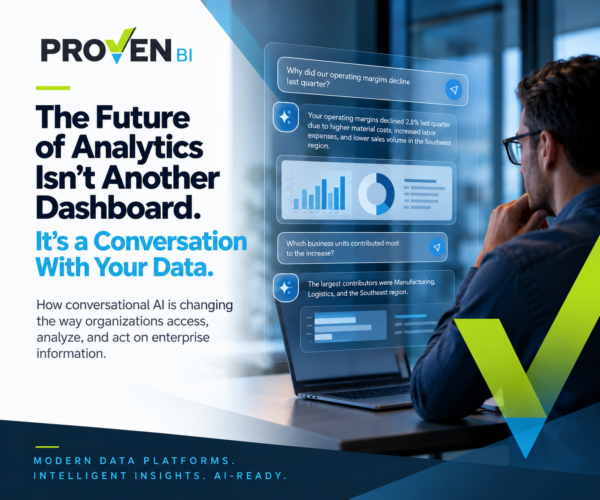
Whether an organization is developing predictive models, implementing conversational AI, deploying AI agents, or enabling natural-language analytics, the quality and accessibility of the underlying data directly influence the reliability of its outputs.
When data is incomplete, inconsistent, outdated, or poorly governed, AI systems can produce misleading results, inaccurate recommendations, and unreliable insights.
This creates a fundamental challenge for business leaders.
How can organizations trust AI-driven decisions if they cannot fully trust the data behind them?
Building a trusted data foundation requires organizations to establish consistent processes for integrating, managing, governing, and delivering information across the enterprise.
This includes ensuring that data is:
- Accurate: Information is reliable and meets established quality standards.
- Consistent: Business metrics and definitions are standardized across systems.
- Accessible: Authorized users and applications can access the information they need.
- Governed: Policies establish how data is managed, secured, and used.
- Traceable: Data lineage provides visibility into where information originates and how it changes.
- Scalable: The architecture can accommodate increasing data volumes and evolving business requirements.
These capabilities are essential not only for AI but also for enterprise reporting, operational analytics, financial visibility, and strategic decision-making.
Modern Data Architecture Is Essential for AI Readiness
Many organizations are attempting to introduce AI into environments that were never designed to support it.
Traditional data warehouses, fragmented integration processes, disconnected reporting systems, and legacy infrastructure can create significant barriers to enterprise AI adoption.
As AI workloads expand, organizations need architectures capable of supporting multiple types of data, analytical workloads, and intelligent applications.
Modern data platforms provide the foundation for bringing these capabilities together.
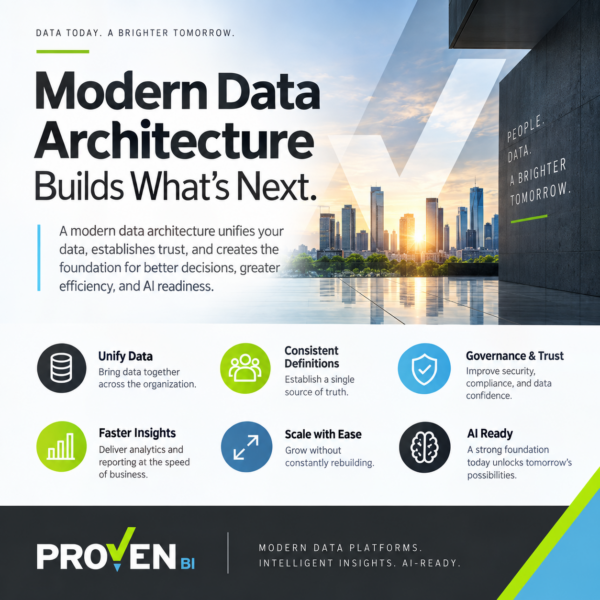
A well-designed modern data architecture can help organizations:
1. Connect Data Across the Enterprise
Integrate information from ERP systems, CRM platforms, operational applications, cloud environments, third-party systems, and legacy databases into a connected data ecosystem.
2. Improve Data Quality and Consistency
Establish standardized transformation processes, business definitions, and data quality controls that improve confidence in reporting and AI-generated insights.
3. Enable Scalable Analytics and AI
Create an architecture capable of supporting enterprise reporting, advanced analytics, machine learning, generative AI, and intelligent automation.
4. Simplify Data Management
Reduce unnecessary duplication, streamline integration processes, and improve the efficiency of data engineering and platform operations.
5. Support Future Innovation
Build a flexible foundation that allows organizations to adopt emerging technologies without continually redesigning their data environments.
Modernizing a data platform isn’t simply about migrating workloads to the cloud.
It’s about creating an architecture that allows data, analytics, and AI to operate together effectively.
Governance and Security Must Be Built Into AI
As organizations expand their use of AI, data governance and security become increasingly important.
AI introduces new considerations around data access, privacy, regulatory compliance, model behavior, and the responsible use of enterprise information.
These challenges become particularly significant when AI applications interact with sensitive business data or provide recommendations that influence operational and financial decisions.
Organizations need governance frameworks that extend beyond traditional reporting environments.
An effective approach should address several critical areas.
Data Access and Security
Ensure AI applications and users can access only the information they are authorized to use.
Data Lineage and Transparency
Provide visibility into where data originates, how it is transformed, and how it is used within analytical and AI applications.
Consistent Business Definitions
Establish governed metrics and semantic models so AI applications interpret business information consistently.
Data Quality Monitoring
Implement processes that continuously evaluate data accuracy, completeness, and reliability.
Responsible AI Practices
Establish policies and oversight for AI development, deployment, monitoring, and ongoing operations.
Governance should not be viewed as an obstacle to innovation.
When implemented correctly, governance enables organizations to innovate with greater confidence while reducing operational and security risks.
Enterprise Integration Turns AI Into Business Value
One of the biggest differences between experimenting with AI and successfully deploying it across an organization is integration.
An AI application may demonstrate impressive capabilities in a controlled environment, but its real value emerges when it becomes part of everyday business operations.
For example, organizations may want to use AI to:
- Allow executives to ask natural-language questions about financial and operational performance.
- Automate repetitive workflows across enterprise applications.
- Identify emerging trends and anomalies in business data.
- Improve forecasting and predictive decision-making.
- Provide employees with intelligent access to enterprise knowledge.
- Deploy AI agents that support business processes and operational activities.
Delivering these capabilities requires more than connecting an AI model to a database.
Organizations must establish secure, reliable connections between AI applications, enterprise data, business logic, and operational systems.
They also need to ensure that AI-generated insights align with approved business definitions and existing security policies.
The objective is not simply to make AI available. It’s to make AI useful, reliable, and integrated into how the business operates.
Moving From AI Experimentation to Production
Many organizations have already demonstrated that AI can deliver value through pilot programs and proof-of-concept initiatives.
The next challenge is operationalizing those capabilities.
Moving AI into production requires organizations to think beyond individual use cases and establish an enterprise-wide approach.
This means evaluating several important questions:
Is our data foundation ready?
Can AI applications access accurate, connected, and governed enterprise information?
Can our architecture scale?
Will our existing data environment support additional AI workloads, users, applications, and business requirements?
Do we have the right governance controls?
Can we manage data access, security, compliance, and responsible AI practices consistently?
Are our business metrics standardized?
Will AI applications produce insights based on the same definitions used throughout the organization?
Can we measure business outcomes?
Are we evaluating AI initiatives based on improvements in efficiency, decision-making, operational performance, and measurable return on investment?
Organizations that address these questions early are better positioned to transition from isolated experiments to scalable enterprise capabilities.
Building an AI-Ready Organization Starts With a Strategy
AI readiness is not achieved by implementing a single technology or launching an individual project.
It requires a coordinated strategy that connects business objectives, data architecture, governance, analytics, and AI capabilities.
For many organizations, the most effective starting point is evaluating their existing data environment.
A data and AI readiness assessment can help identify:
- Gaps in the current data architecture.
- Opportunities to consolidate disconnected data environments.
- Data quality and governance challenges.
- Limitations affecting reporting and analytics.
- Security and access control considerations.
- High-value opportunities for AI and automation.
- A practical roadmap for modernization and AI adoption.
Rather than attempting to modernize everything at once, organizations can prioritize initiatives that address immediate business challenges while establishing a foundation for future growth.
This approach helps align technology investments with measurable business outcomes.
AI readiness should be approached as a business transformation initiative supported by a modern data strategy.
How ProvenBI Helps Organizations Build Trusted, AI-Ready Data Foundations
At ProvenBI, we help organizations transform complex data environments into modern, scalable platforms designed to support enterprise analytics and artificial intelligence.
Our approach focuses on establishing the architectural, engineering, and governance capabilities organizations need to confidently expand their use of data and AI.
Our services include:
Data Strategy and Architecture
Designing modern data architectures aligned with business objectives, operational requirements, and long-term technology strategies.
Data Platform Modernization
Modernizing legacy environments and implementing scalable platforms that support data integration, analytics, and AI workloads.
Data Engineering and Integration
Connecting enterprise applications, developing reliable data pipelines, and transforming fragmented information into accessible, trusted data assets.
Data Governance and Quality
Establishing governance frameworks, security controls, data quality processes, and consistent business definitions.
Advanced Analytics and Business Intelligence
Developing reporting and analytics solutions that provide organizations with accurate, timely, and actionable insights.
AI Readiness and Enablement
Preparing enterprise data environments to support generative AI, conversational analytics, intelligent automation, AI agents, and advanced analytical applications.
Our objective is to help organizations move beyond disconnected technology initiatives and establish a unified foundation for intelligent business operations.
Modern Data Platforms. Intelligent Insights. AI-Ready.
The Future of AI Will Be Built on Trust
AI will continue to transform how organizations operate, analyze information, and make decisions.
However, the organizations that realize the greatest long-term value from AI will not necessarily be those that adopt the technology first.
They will be those that build the right foundation to support it.
Trusted data, modern architecture, strong governance, and enterprise integration are not optional components of a successful AI strategy.
They are essential capabilities for scaling AI responsibly and delivering sustainable business value.
At ProvenBI, we believe organizations should approach AI with a clear understanding of their existing data capabilities and a practical roadmap for modernization.
Because the ultimate goal isn’t simply to launch AI initiatives.
It’s to move AI into production, scale it responsibly, and deliver measurable business outcomes.
Is Your Organization Ready to Scale AI?
If your organization is exploring AI, modernizing its data platform, or looking to improve the reliability of enterprise analytics, the first step is understanding whether your current data foundation can support your objectives.
ProvenBI can help you evaluate your data environment, identify opportunities for modernization, and develop a strategy for building a trusted, AI-ready platform.
Let’s discuss how to turn your data foundation into a competitive advantage.
Contact ProvenBI to start the conversation.
ProvenBI | Modern Data Platforms. Intelligent Insights. AI-Ready.