Artificial intelligence is transforming how organizations operate, make decisions, serve customers and compete. However, despite the growing investment in AI technologies, many organizations struggle to move beyond experimentation and deliver measurable business value.
The challenge isn’t necessarily the AI technology itself. It’s the foundation supporting it.
Successful AI adoption requires more than selecting the right tools, deploying large language models or introducing AI assistants. It requires a coordinated approach that brings together business strategy, data, technology, governance and people.
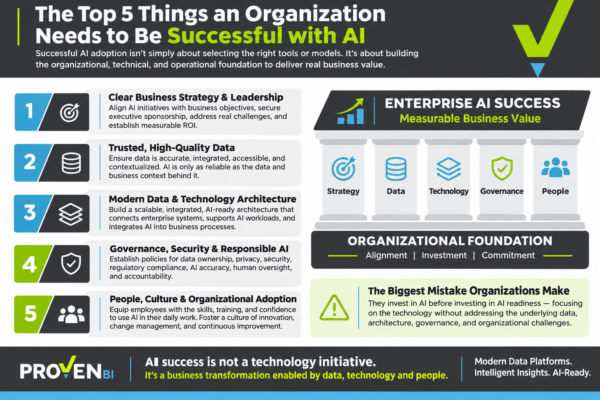
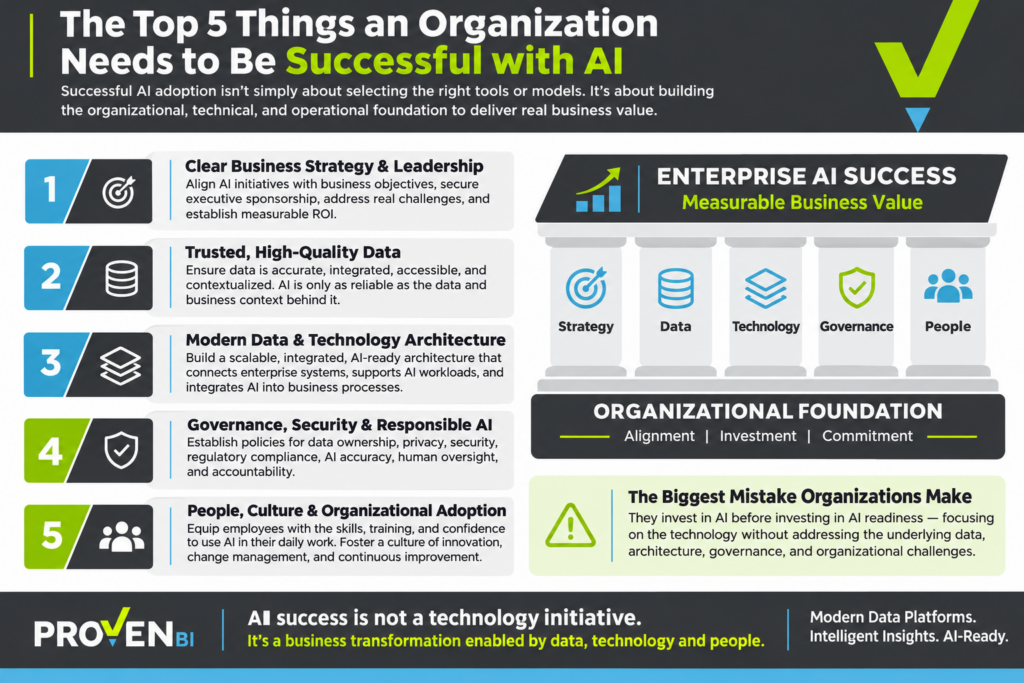
Organizations looking to achieve sustainable enterprise AI success should focus on five foundational pillars.
1. Clear Business Strategy & Leadership
AI should be driven by business objectives, not technology capabilities.
Organizations must identify where AI can create meaningful value, whether through operational efficiency, revenue growth, improved customer experiences, reduced costs or better decision-making.
A successful AI strategy should include:
- Executive sponsorship and organizational alignment.
- Clearly defined business objectives.
- Prioritized AI use cases.
- Measurable success criteria and ROI.
- A roadmap for enterprise-wide adoption.
Without a clear strategy, AI initiatives risk becoming disconnected experiments rather than meaningful business investments.
2. Trusted, High-Quality Data
Data is the foundation of enterprise AI.
Organizations cannot expect AI to consistently deliver accurate, reliable and meaningful insights when their underlying data is fragmented, incomplete, inconsistent or outdated.
Building an AI-ready data foundation requires:
- Integration of data across enterprise systems.
- Automated data ingestion and transformation.
- Data quality and validation processes.
- Consistent business definitions and semantic models.
- Accessible, contextualized and trusted data.
AI needs more than access to information. It needs to understand the relationships, definitions and business context behind that information.
A powerful AI model cannot compensate for an unreliable data foundation.
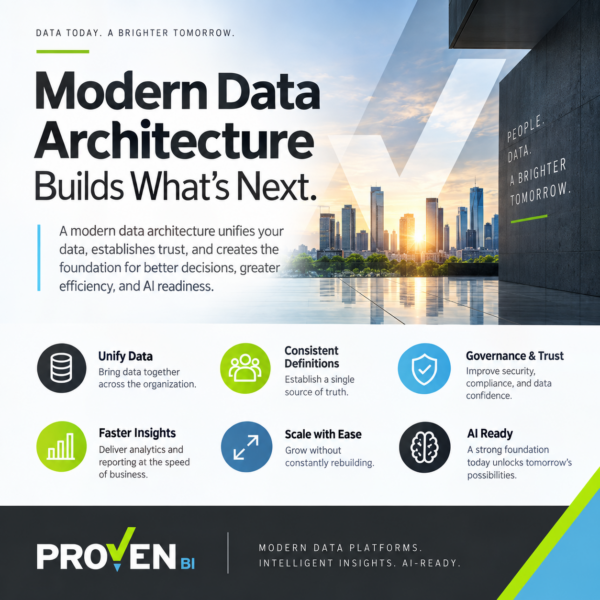
3. Modern Data & Technology Architecture
Traditional data environments were not always designed to support the demands of modern analytics and enterprise AI.
Organizations need scalable, flexible architectures that enable data integration, advanced analytics, machine learning, conversational AI and intelligent automation.
Key architectural capabilities include:
- Modern cloud data platforms.
- Lakehouse and medallion architectures.
- Reusable data ingestion and transformation frameworks.
- Governed semantic and business-ready data layers.
- Integration with enterprise applications and workflows.
- Scalable infrastructure supporting AI models and agents.
Platforms such as Microsoft Fabric and Databricks provide powerful capabilities for building these environments. However, the platform itself is only part of the solution.
How the architecture is designed, implemented, governed and maintained ultimately determines how effectively it supports enterprise AI.
4. Governance, Security & Responsible AI
As AI becomes more deeply integrated into business operations, governance and security become increasingly important.
Organizations must establish controls that protect sensitive information, maintain regulatory compliance and ensure AI-generated outputs are appropriately validated.
An effective governance framework should address:
- Data ownership and stewardship.
- Role-based access and security.
- Data privacy and regulatory compliance.
- Data lineage and transparency.
- AI accuracy, reliability and monitoring.
- Human oversight and accountability.
Governance should not be treated as a barrier to innovation. It should be designed as an enabler that allows organizations to confidently scale AI across the enterprise.
Trust is essential to adoption. If employees and business leaders cannot trust the information AI provides, its long-term value will be limited.
5. People, Culture & Organizational Adoption
Even the most advanced AI solutions will struggle to deliver value if people do not understand, trust or use them.
Successful AI adoption requires organizations to rethink how employees interact with data, make decisions and perform their daily responsibilities.
This includes:
- Employee education and AI literacy.
- Organizational change management.
- Integration of AI into existing business workflows.
- Collaboration between business and technology teams.
- Continuous feedback and improvement.
- A culture that encourages responsible innovation.
AI should empower employees, reduce manual effort and create opportunities for more strategic work.
The goal is not simply to deploy AI. It is to change how the organization operates and creates value.
The Biggest Mistake Organizations Make
One of the biggest mistakes organizations make is investing in AI before investing in AI readiness.
They prioritize AI applications, assistants and models without addressing the underlying challenges that can limit their effectiveness:
- Fragmented enterprise data.
- Legacy technology environments.
- Inconsistent business definitions.
- Limited governance and security.
- Unclear business objectives.
- Insufficient organizational adoption.
This can lead to disconnected solutions, unreliable results, increased costs and difficulty scaling AI initiatives.
Rather than starting with the question, “What AI tools should we implement?” organizations should be asking:
“Do we have the foundation necessary to make AI successful?”
Moving From AI Experimentation to Enterprise AI Success
AI readiness is not a one-time project. It is an ongoing organizational commitment that requires alignment, investment and continuous improvement.
At ProvenBI, we help organizations establish the data and technology foundations necessary to support modern analytics and enterprise AI.
Our approach focuses on:
- Data strategy and AI readiness assessments.
- Enterprise data modernization.
- Microsoft Fabric and Databricks implementations.
- Data integration, engineering and architecture.
- Data governance and security.
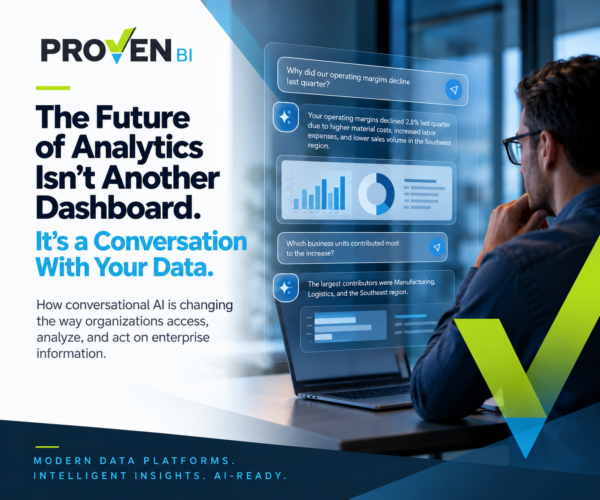
- Advanced analytics and conversational AI.
- Ongoing platform optimization and support.
By establishing trusted, scalable and AI-ready data environments, organizations can move beyond isolated AI initiatives and create a foundation for sustainable innovation.
Building the Foundation for What’s Next
The organizations that will be most successful with AI are not necessarily those that adopt it first or invest the most in technology. They are those that establish the right foundation to use AI effectively, responsibly and at scale.
Business strategy, trusted data, modern architecture, governance and people must work together to turn AI capabilities into meaningful business outcomes.
AI success is not a technology initiative. It’s a business transformation enabled by data, technology and people.
Is Your Organization Truly AI-Ready?
Contact ProvenBI to learn how we can help your organization build the foundation for enterprise AI success.
Modern Data Platforms. Intelligent Insights. AI-Ready.