Organizations are moving quickly toward AI, automation, real-time analytics, and more intelligent decision-making.
But many are trying to build these capabilities on top of data environments that were never designed to support them.
Data remains spread across applications. Business logic lives inside individual reports. Definitions vary between departments. Legacy integrations become increasingly difficult to maintain. And every new analytics or AI initiative adds another layer of complexity.
The challenge isn’t simply having more data.
It’s having the right architecture underneath it.
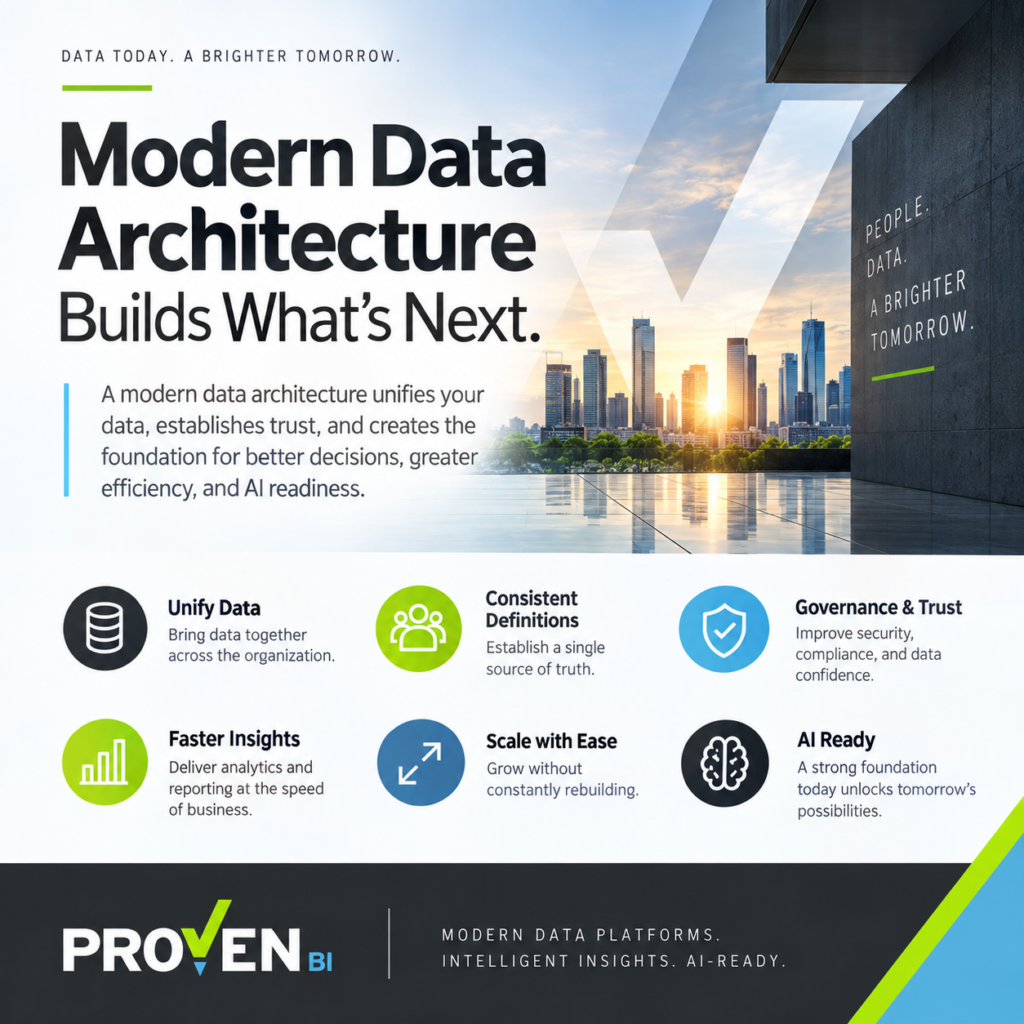
A modern data architecture creates the foundation organizations need to turn complex data environments into trusted, scalable platforms for analytics and AI.
The Problem With Legacy Data Environments
Most enterprise data environments didn’t become complicated overnight.
They evolved.
New applications were added. Acquisitions introduced additional systems. Departments created their own reporting solutions. Point-to-point integrations accumulated. Business rules were duplicated across dashboards, spreadsheets, databases, and applications.
Eventually, organizations find themselves managing an environment where:
- Data exists in disconnected silos
- The same metric can have multiple definitions
- Reporting requires significant manual effort
- Data pipelines are fragile and difficult to maintain
- Governance and lineage are unclear
- Scaling analytics becomes increasingly expensive
- AI initiatives struggle to access trusted, business-ready data
The result is often a technology environment that can produce reports but struggles to consistently produce trusted intelligence at scale.
What Is Modern Data Architecture?
Modern data architecture is not simply moving databases to the cloud or purchasing another analytics platform.
It is the intentional design of how data is collected, integrated, stored, transformed, governed, secured, modeled, and consumed across the organization.
The goal is to create an architecture where data can move efficiently from operational systems into a governed platform that supports multiple business needs.
That can include:
Analytics and BI → Operational Reporting → Automation → Data Products → Advanced Analytics → AI
Instead of building separate infrastructure for every new use case, organizations create a common data foundation capable of supporting what comes next.
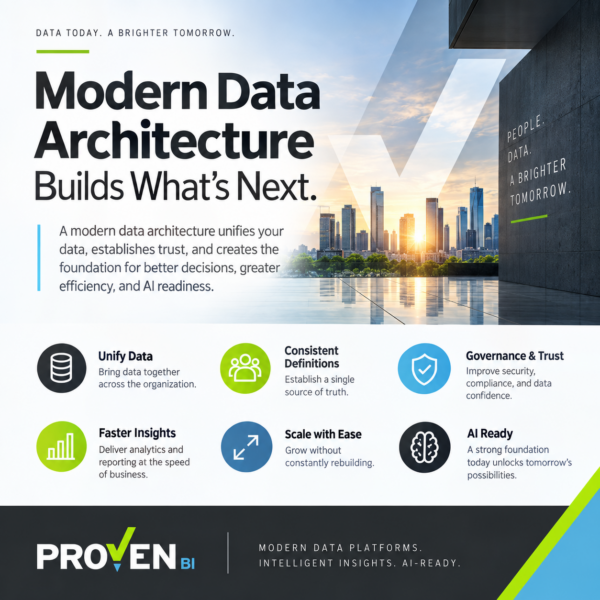
Six Capabilities a Modern Data Architecture Should Deliver
1. Unified Data
Organizations need the ability to bring data from ERP, CRM, financial, operational, clinical, SaaS, third-party, and other systems into a common architecture.
This doesn’t necessarily mean everything lives in one database.
It means the organization has an intentional architecture for connecting and managing its data rather than allowing every application and department to operate independently.
2. Consistent Business Definitions
One of the biggest data challenges isn’t technology.
It’s agreement.
What exactly is revenue?
Who qualifies as an active customer?
How is margin calculated?
Which system owns the official definition?
Modern architecture provides a place to centralize business rules and create governed, reusable definitions.
The objective is simple:
One business should not have five different versions of the truth.
3. Governance and Trust
More data only creates more value when people trust it.
Modern architecture should make governance part of the foundation rather than something added after implementation.
That includes ownership, security, lineage, metadata, access controls, data quality, and clearly defined business logic.
ProvenBI’s architecture philosophy reflects this foundation-first approach: advanced analytics and AI deliver value when foundational data capabilities are in place.
4. Faster Insights
Traditional environments often require data teams to spend significant time moving, cleaning, reconciling, and validating data before the business can use it.
A well-designed modern platform creates repeatable data pipelines and reusable data assets.
Instead of continually rebuilding the same integrations and transformations, teams can spend more time delivering insights.
The conversation begins to move from:
“Can we get the data?”
to:
“What is the data telling us?”
5. Scalability
Business requirements will change.
New systems will be implemented. Companies will acquire businesses. Data volumes will increase. New analytics requirements will emerge.
A modern architecture should anticipate change.
Organizations shouldn’t have to redesign their entire data environment every time a new source, dashboard, business unit, or AI use case is introduced.
Architecture should create a framework that allows the data environment to evolve with the business.
6. AI Readiness
This may be one of the most important reasons organizations should be thinking about architecture today.
There is tremendous pressure to implement AI.
But AI doesn’t eliminate underlying data problems.
It exposes them.
AI systems still need access to accurate, governed, secure, contextualized enterprise data.
If the underlying data is fragmented, inconsistent, poorly governed, or inaccessible, adding AI does not magically solve those problems.
AI readiness doesn’t start with AI. It starts with the data foundation.
That is why modern data architecture is becoming increasingly important as organizations move from AI experimentation toward enterprise adoption.
Architecture Before Tools
One of the most common mistakes organizations make is starting with technology.
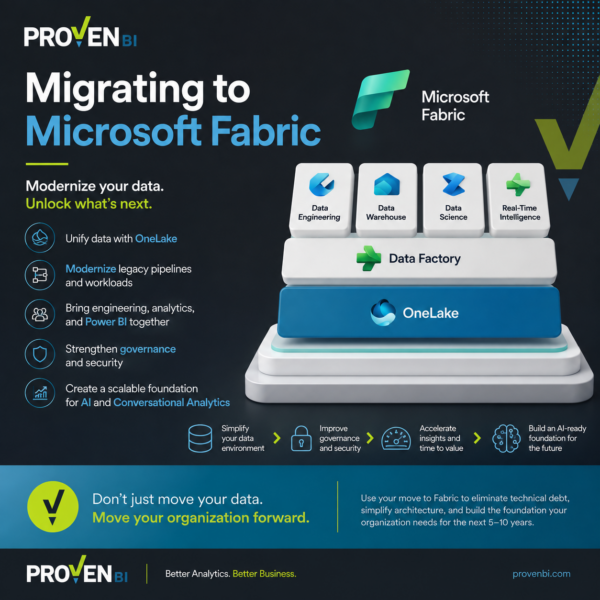
Should we use Microsoft Fabric?
Databricks?
Azure?
Snowflake?
Power BI?
Those can all be important decisions, but they come after a more fundamental question:
What architecture does the business actually need?
Technology should support the architecture, not define it.
The right architecture considers the organization’s data sources, security requirements, governance model, business processes, analytics requirements, growth expectations, existing technology investments, and future AI strategy.
Only then should technology decisions be made.
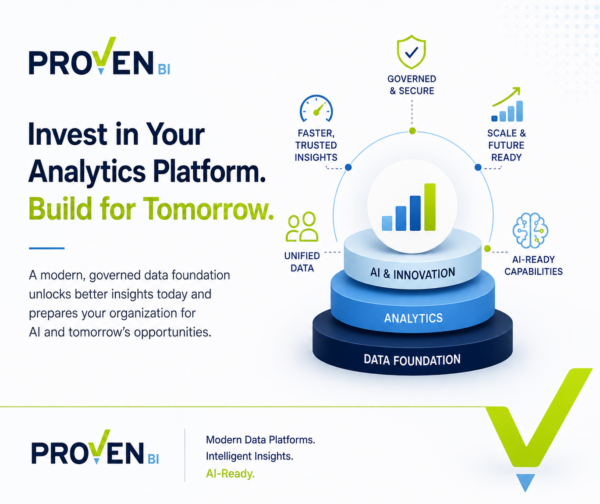
Build for Tomorrow, Not Just Today
Modernizing a data environment shouldn’t be about replacing technology simply because something newer exists.
The objective should be to build a foundation that creates measurable business value today while positioning the organization for what comes next.
That means creating an environment capable of supporting better analytics today, greater automation tomorrow, and enterprise AI as those capabilities mature.
At ProvenBI, we help organizations assess, architect, modernize, and build data platforms designed around that philosophy.
Because the goal isn’t simply modern technology.
The goal is trusted data, better decisions, and an architecture capable of supporting what comes next.
Ready to Modernize Your Data Foundation?
Whether you’re modernizing legacy infrastructure, improving analytics, implementing Microsoft Fabric or Azure, or preparing your organization for AI, the right architecture is where it starts.
Modern Data Platforms. Intelligent Insights. AI-Ready.