Executive Summary
Data has become one of the most valuable assets within any organization. Yet for many businesses, data remains fragmented across dozens of applications, spreadsheets, databases, cloud platforms, and departments. While organizations continue investing in analytics, automation, and artificial intelligence (AI), many are attempting to build these capabilities on outdated architectures that were never designed for today’s business demands.
The result is slow reporting, inconsistent metrics, increasing technical debt, rising operational costs, and AI initiatives that struggle to deliver measurable business value.
A modern data platform changes that.
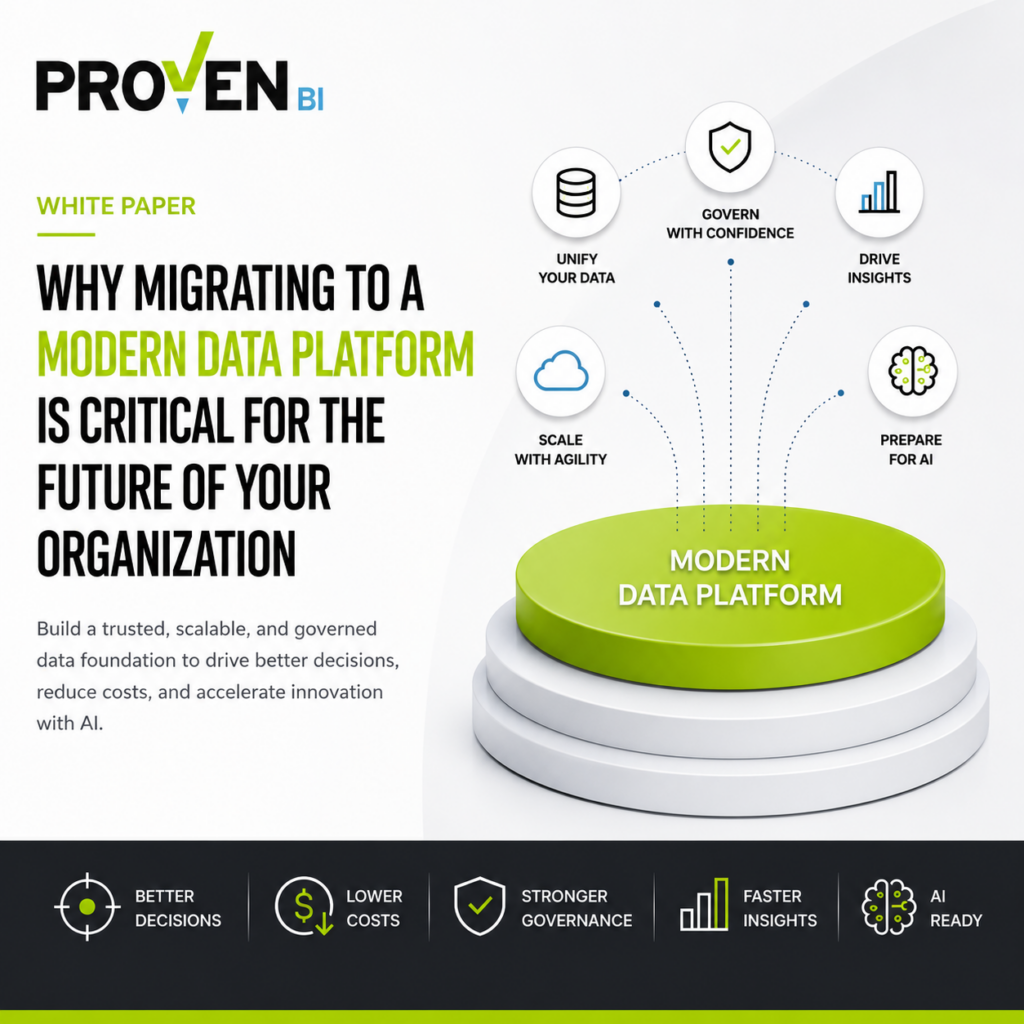
Rather than simply replacing technology, a modern data platform creates a trusted, scalable, and governed foundation that enables organizations to make better decisions, operate more efficiently, innovate faster, and prepare for the future.
The organizations that invest in their data foundation today will be the ones best positioned to compete tomorrow.
The Challenge Organizations Face Today
Every organization generates data. The problem is not collecting it.
The challenge is turning that data into consistent, trusted, and actionable information.
Over time, organizations naturally accumulate technology:
- ERP systems
- CRM platforms
- Financial applications
- HR systems
- Operational software
- Cloud applications
- Legacy databases
- Department-managed spreadsheets
Each system contains valuable information, but each tells only part of the story.
Without a centralized strategy, organizations often experience:
- Multiple versions of the truth
- Manual reporting processes
- Duplicate data
- Inconsistent business definitions
- Slow access to information
- Limited visibility across departments
- Increasing maintenance costs
- Difficulty scaling analytics
As organizations grow, these challenges only become more complex.
Why Legacy Architectures Are Holding Organizations Back
Many data warehouses and reporting environments were built years ago to solve yesterday’s business problems.
They were designed primarily for:
- Static reporting
- Historical analysis
- Small data volumes
- Limited users
- On-premises infrastructure
Today’s organizations require much more.
Business leaders expect:
- Real-time insights
- Self-service analytics
- Cross-functional reporting
- Cloud scalability
- AI-ready data
- Advanced analytics
- Predictive modeling
- Automated decision support
Legacy architectures struggle to deliver these capabilities without significant complexity and cost.
Organizations often find themselves maintaining multiple disconnected tools simply to answer basic business questions.
What Is a Modern Data Platform?
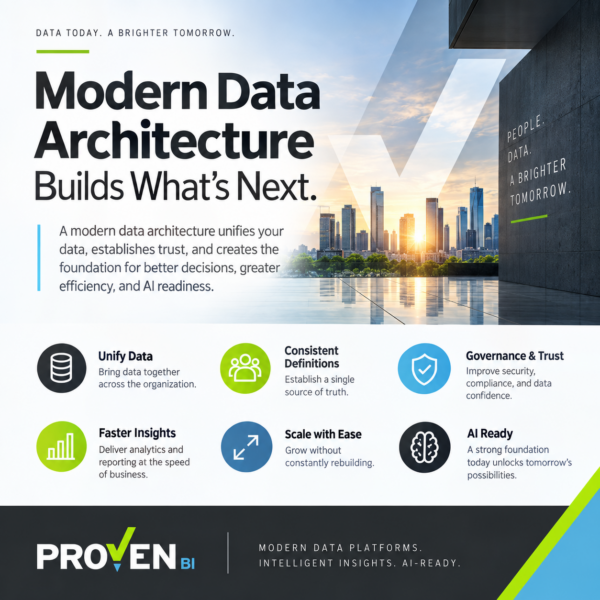
A modern data platform is a unified architecture designed to collect, manage, govern, and deliver trusted data across the enterprise.
Rather than focusing solely on reporting, it provides the foundation for:
- Business intelligence
- Operational reporting
- Data science
- Machine learning
- Artificial intelligence
- Data governance
- Automation
- Application integration
A modern platform brings together structured and unstructured data into a scalable environment where data can be trusted, secured, and reused across the organization.
More importantly, it separates business logic from reporting tools, allowing every dashboard, application, and AI model to work from consistent, governed data.
The Business Benefits
Better Decision Making
Executives spend less time questioning reports and more time making informed decisions.
When everyone uses the same trusted data, confidence increases across the organization.
Faster Access to Insights
Instead of waiting days or weeks for reports, business users gain timely access to information that supports operational and strategic decisions.
Improved Data Quality
Centralized validation, cleansing, and governance improve data consistency while reducing errors across departments.
Reduced Operational Costs
Consolidating fragmented reporting environments reduces maintenance, simplifies support, and lowers infrastructure costs.
Organizations also spend less time manually preparing data.
Stronger Governance and Security
Modern platforms provide centralized control over:
- Data lineage
- Metadata
- Access controls
- Compliance
- Auditing
- Data quality
Governance becomes embedded into the platform rather than added afterward.
Scalability for Future Growth
As organizations expand through acquisitions, new applications, or increased data volumes, a modern platform scales without requiring complete redesigns.
Preparing for Artificial Intelligence
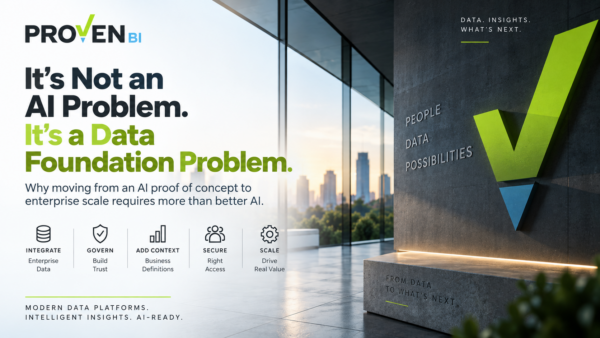
Many organizations believe AI begins with selecting the right model or software.
In reality, AI begins with trusted data.
Artificial intelligence depends on:
- Accurate information
- Consistent business definitions
- Reliable historical data
- Well-governed data assets
- Secure access
- High-quality metadata
Without these foundations, AI produces inconsistent results and loses organizational trust.
Organizations investing in modern data platforms are building the infrastructure necessary to support AI initiatives that can scale beyond isolated pilot projects.
Moving Beyond Reporting
Historically, organizations viewed data platforms primarily as reporting solutions.
That mindset is changing.
Modern platforms increasingly support enterprise-wide capabilities such as:
- Predictive analytics
- Process automation
- Customer personalization
- Operational optimization
- Digital transformation
- Embedded analytics
- AI copilots
- Intelligent applications
Reporting becomes only one consumer of the enterprise data platform.
The platform itself becomes a strategic business asset.
Common Signs It’s Time to Modernize
Many organizations delay modernization until problems become unavoidable.
Common indicators include:
- Reports rarely match across departments.
- Business users rely heavily on spreadsheets.
- Data exists in numerous disconnected systems.
- Reporting requires extensive manual effort.
- Analytics projects take months to deliver.
- IT spends more time maintaining systems than improving them.
- Executives lack real-time visibility into operations.
- AI initiatives are stalled due to poor data quality.
- Governance efforts are inconsistent or reactive.
If several of these challenges exist, modernization is no longer a technology initiative—it is a business priority.
Modernization Is More Than a Technology Project
Successful organizations recognize that data platform modernization is not simply replacing software.
It requires alignment across:
- Business strategy
- Data architecture
- Governance
- Security
- Integration
- Data quality
- Operating processes
- Organizational adoption
Technology enables transformation, but strategy ensures long-term success.
Organizations that focus only on tools often recreate the same problems on newer platforms.
Those that prioritize architecture, governance, and business alignment build foundations that continue delivering value for years.
Building for the Next Decade
The pace of innovation continues to accelerate.
Organizations will increasingly rely on data to support:
- Artificial intelligence
- Automation
- Customer experience
- Digital services
- Predictive operations
- Real-time decision making
- Advanced analytics
These capabilities cannot be layered effectively onto fragmented legacy environments.
A modern data platform provides the flexibility to adapt as technologies evolve without repeatedly rebuilding the organization’s data ecosystem.
It creates a durable foundation capable of supporting future business initiatives, regardless of which technologies emerge next.
Conclusion
Data is no longer just an operational byproduct. It is a strategic asset that influences nearly every business decision.
Organizations that continue relying on fragmented legacy architectures risk slower decision making, higher costs, inconsistent reporting, and limited ability to capitalize on AI and advanced analytics.
Migrating to a modern data platform is not simply an IT upgrade. It is an investment in the future of the organization.
By creating a trusted, scalable, and governed data foundation, organizations position themselves to innovate faster, improve operational efficiency, strengthen decision making, and confidently embrace emerging technologies.
The question is no longer whether organizations should modernize their data platform.
The question is whether they will do so before their competitors gain the advantage.