Artificial Intelligence has quickly moved from experimentation to everyday business. One of the fastest-growing applications is Conversational AI—technology that enables users to interact with systems using natural language instead of navigating menus, reports, or complex applications.
From customer service chatbots to AI-powered business assistants, Conversational AI is transforming how organizations engage with customers, employees, and data.
But while many organizations focus on selecting the right AI platform or large language model (LLM), they often overlook the factor that has the greatest impact on success:
The quality of the data behind it.
What Is Conversational AI?
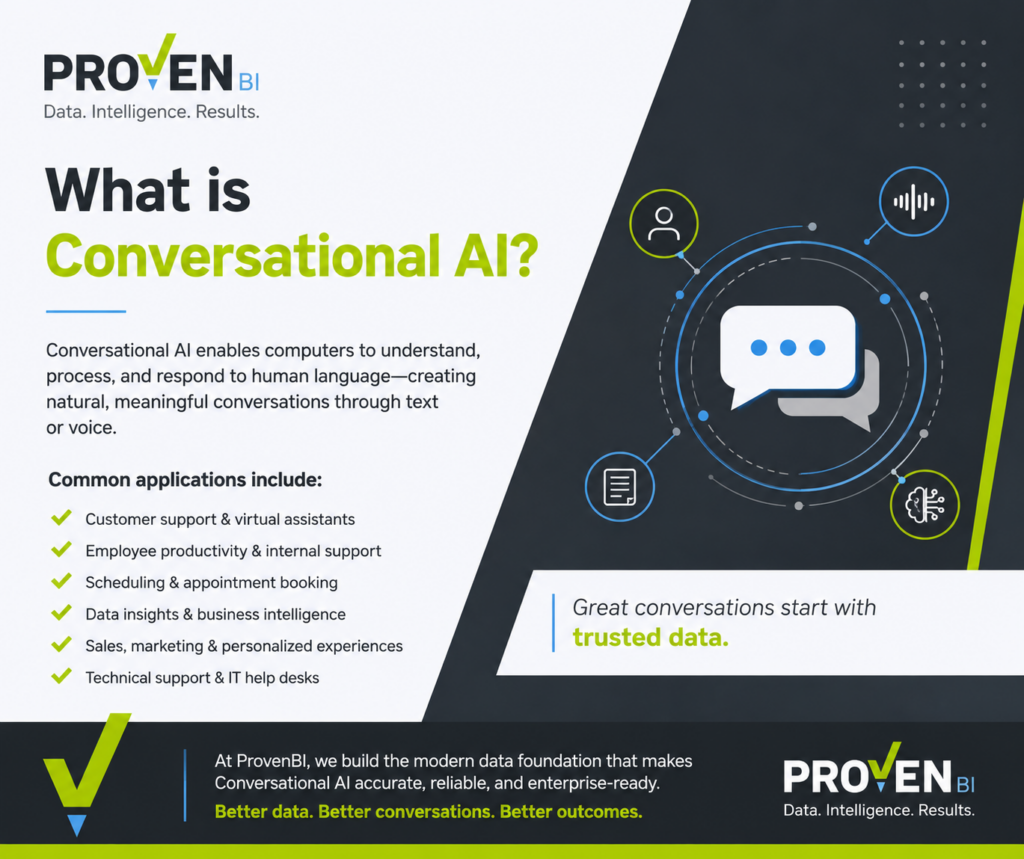
Conversational AI is a combination of artificial intelligence, natural language processing (NLP), machine learning, and large language models that allows computers to understand, interpret, and respond to human language.
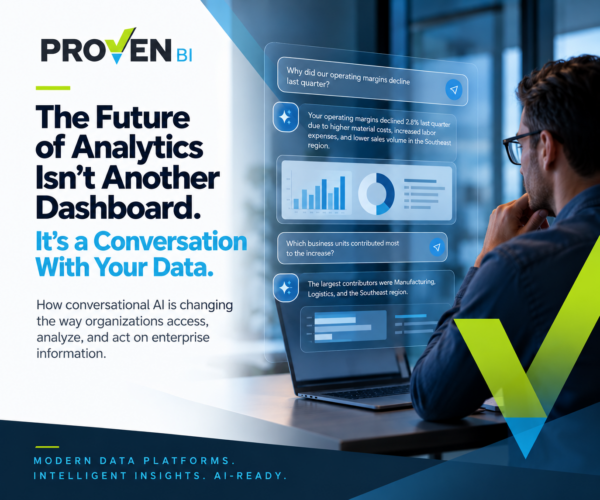
Instead of searching through reports or clicking through applications, users can simply ask questions like:
- “What were our sales last quarter?”
- “Which customers are at risk of churning?”
- “Show me inventory shortages by region.”
- “Summarize today’s operational issues.”
- “How many students enrolled compared to last year?”
The AI understands the request, retrieves relevant information, and delivers an understandable response.
The result is a more intuitive and productive way to interact with business information.
Conversational AI Is More Than Chatbots
Many people still associate Conversational AI with website chatbots.
Today’s enterprise Conversational AI goes much further.
Modern organizations are deploying AI assistants that can:
✔ Answer business questions in real time
✔ Summarize reports and dashboards
✔ Retrieve documents and policies
✔ Guide employees through business processes
✔ Generate insights from enterprise data
✔ Assist customer support teams
✔ Help executives make faster decisions
Instead of replacing existing applications, Conversational AI becomes the natural interface that connects people with them.
Why Organizations Are Investing
The appeal is simple.
People already know how to have conversations.
Learning a new reporting platform takes training.
Asking a question does not.
Organizations are adopting Conversational AI because it:
- Improves employee productivity
- Reduces time spent searching for information
- Accelerates decision-making
- Simplifies customer interactions
- Makes analytics accessible to non-technical users
- Increases adoption of business intelligence investments
When implemented correctly, it allows every employee to interact with enterprise data like they have their own data analyst.
The Hidden Challenge
Here’s where many AI projects struggle.
Organizations invest in sophisticated AI platforms expecting immediate value.
Instead, users receive:
- Different answers to the same question
- Incorrect metrics
- Missing information
- Outdated reports
- Conflicting business definitions
The problem usually isn’t the AI.
It’s the data.
AI simply reflects the quality of the information it’s given.
Conversational AI Is Only As Smart As Your Data
Think of Conversational AI as an incredibly intelligent employee.
Even the smartest employee cannot provide accurate answers if they’re given inconsistent or incomplete information.
The same is true for AI.
If your organization has:
- Multiple versions of customer data
- Different KPI calculations across departments
- Disconnected systems
- Poor governance
- Missing metadata
- Duplicate business logic
Your AI will inherit those same problems.
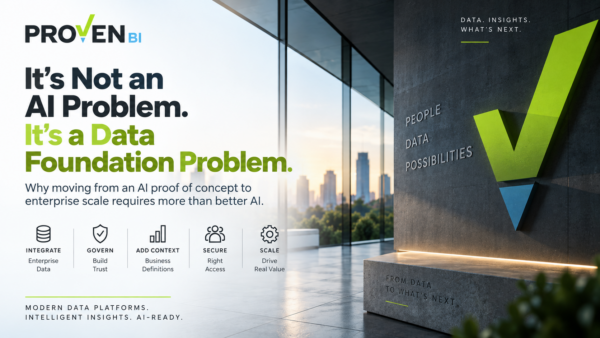
That’s why successful AI initiatives begin with data architecture—not prompts.
The Five Building Blocks of Successful Conversational AI
1. Trusted Data
AI must have access to accurate, validated information.
If users cannot trust the answers, adoption disappears quickly.
Building trust starts with high-quality data.
2. Integrated Systems
Most organizations operate dozens—or even hundreds—of business applications.
ERP
CRM
HR
Finance
Marketing
Operations
Healthcare systems
Student Information Systems
Manufacturing platforms
Conversational AI becomes significantly more valuable when it can access information across all of them rather than operating within isolated silos.
3. Business Definitions and Semantic Models
One of the biggest challenges in analytics is inconsistent business logic.
Ask three departments how they calculate revenue or customer counts, and you may receive three different answers.
Semantic models solve this problem by creating a single, governed definition for business metrics.
This ensures AI delivers consistent responses regardless of who asks the question.
4. Governance and Security
Not everyone should have access to every piece of information.
Conversational AI must respect existing security models by:
- Honoring user permissions
- Protecting sensitive information
- Maintaining compliance requirements
- Auditing responses
- Preserving data lineage
Enterprise AI requires enterprise governance.
5. A Modern Data Platform
Legacy architectures often struggle to support modern AI workloads.
Organizations are increasingly adopting modern data platforms built on technologies like:
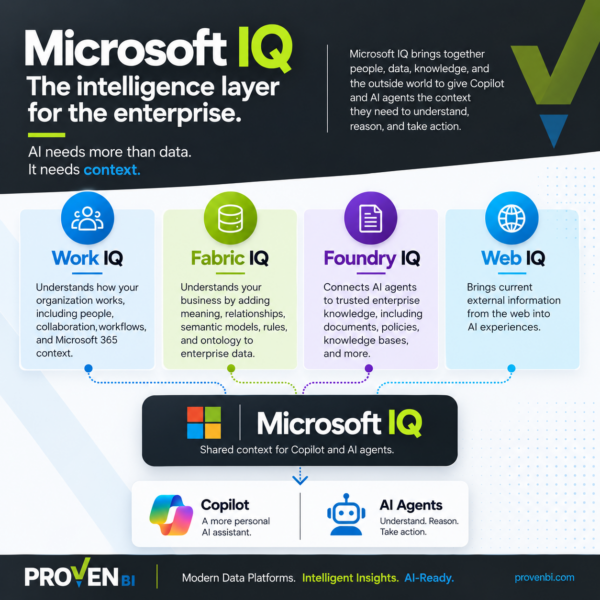
- Microsoft Fabric
- Azure Databricks
- OneLake
- Azure Synapse
- Delta Lake
These platforms unify data engineering, governance, analytics, and AI into a single architecture capable of supporting enterprise-scale Conversational AI.
The Future of Business Intelligence
Traditional dashboards aren’t disappearing.
They’re evolving.
Instead of navigating multiple dashboards to find an answer, users will increasingly ask questions directly.
Rather than replacing Business Intelligence, Conversational AI makes it more accessible.
Imagine asking:
“Why did revenue decline in the Southeast region?”
Instead of opening six dashboards, filtering data, and exporting spreadsheets, AI retrieves the relevant information and provides an explanation in seconds.
That changes how organizations make decisions.
Why Data Architecture Matters More Than Ever
Many organizations believe AI begins with selecting a model.
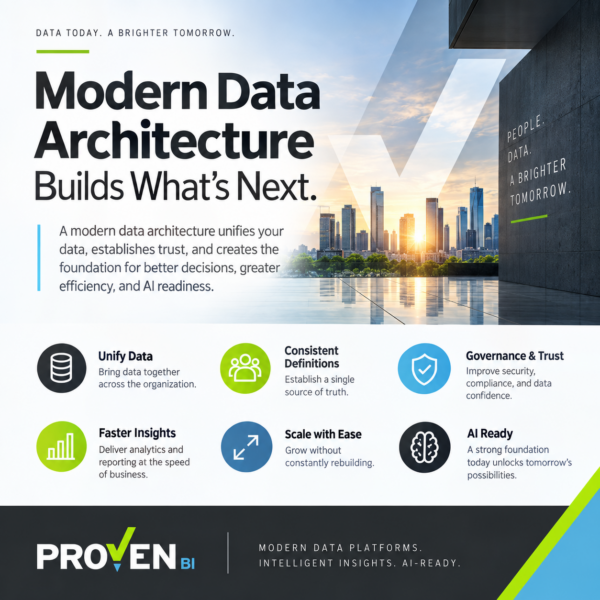
In reality, AI begins with building a trusted data foundation.
Organizations that invest in modern data architecture today will be better positioned to adopt future AI capabilities as they emerge.
Those that don’t may find themselves spending more time fixing data issues than realizing AI’s potential.
The companies that gain the greatest advantage from Conversational AI won’t necessarily have the most advanced models.
They’ll have the best data.
How ProvenBI Helps
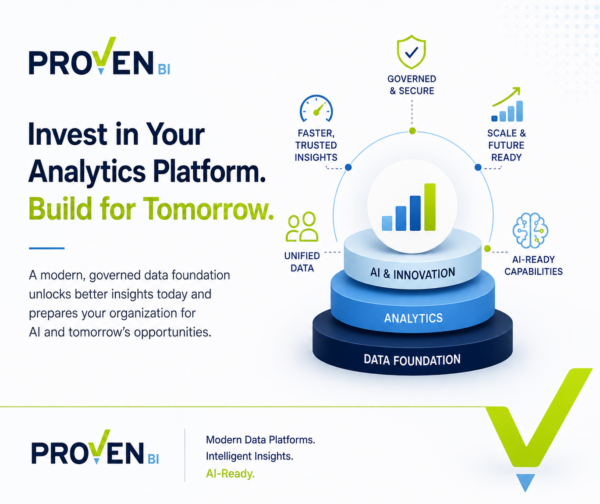
At ProvenBI, we help organizations design and implement modern, governed, and scalable data platforms that make enterprise AI possible.
Whether you’re modernizing your analytics environment, implementing Microsoft Fabric, or preparing your organization for AI, our focus remains the same:
- Build trusted data foundations.
- Unify enterprise data.
- Govern business logic.
- Enable reliable analytics.
- Prepare organizations for the future of AI.
Because Conversational AI isn’t just about having smarter conversations.
It’s about ensuring every conversation is built on trusted data.
Ready for Conversational AI?
Before investing in another AI solution, ask yourself one question:
Can your data provide answers your business can trust?
If the answer is uncertain, your AI strategy should begin with your data strategy.
At ProvenBI, we help organizations build modern data platforms that transform complex data environments into trusted, scalable foundations for analytics and AI. Because great conversations start with trusted data.