For years, the enterprise data warehouse has been the foundation of business intelligence. It provided organizations with a centralized place to store data, build reports, and measure business performance. For a long time, that architecture worked well.
But business has changed.
Organizations are no longer analyzing data from just an ERP system or CRM. Today, data is flowing from cloud applications, APIs, IoT devices, customer interactions, websites, mobile apps, documents, images, and countless other sources. At the same time, businesses are trying to leverage artificial intelligence, machine learning, predictive analytics, and real-time reporting to make faster, more informed decisions.
The problem is that most traditional data warehouse architectures were never designed for this world.
As organizations continue investing in digital transformation, many are discovering that the biggest obstacle isn’t AI or analytics—it’s the architecture behind their data.
The Traditional Data Warehouse Served Its Purpose
Traditional enterprise data warehouses transformed business reporting. They centralized data that had previously been scattered across operational systems and provided consistent reporting across departments.
A typical architecture looked something like this:
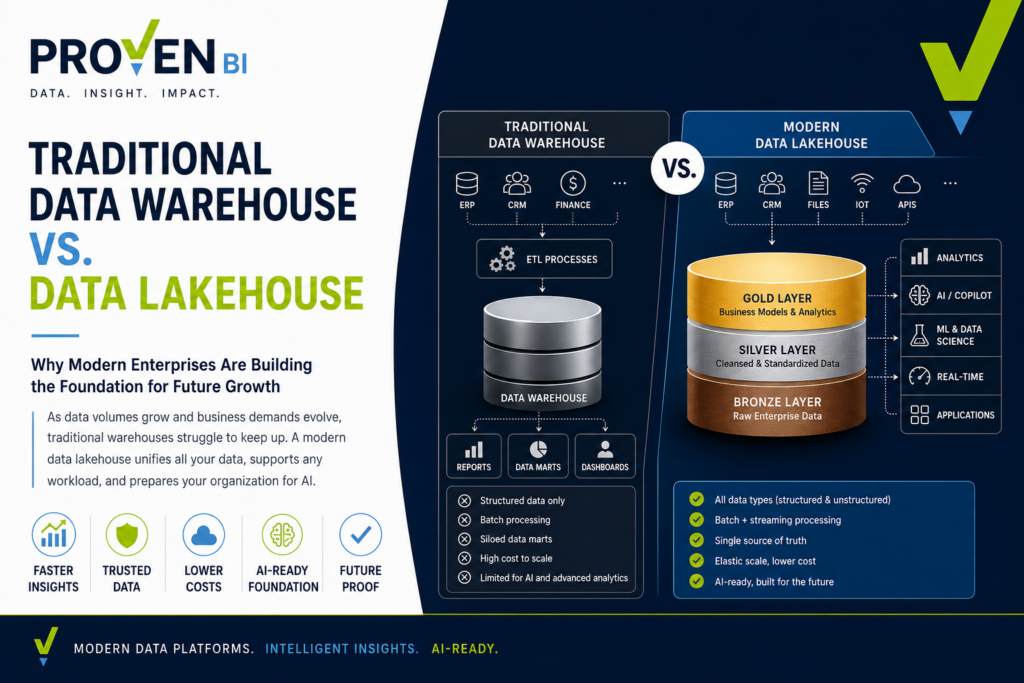
Operational Systems → ETL Processes → Enterprise Data Warehouse → Reports & Dashboards
For years, this approach delivered tremendous value. Finance, operations, sales, and executive leadership could finally work from standardized reports instead of disconnected spreadsheets.
However, these environments were designed for a very different era.
Most assumed:
- Structured relational data
- Nightly batch processing
- Predictable reporting requirements
- Limited data volumes
- Traditional business intelligence
Today’s organizations require much more.
The Modern Data Challenge
Businesses now generate data at an unprecedented scale.
Customer interactions happen across websites, mobile applications, social media, call centers, and connected devices. Manufacturers collect machine telemetry in real time. Healthcare organizations integrate clinical, financial, and operational systems. Retailers analyze purchasing behavior, inventory, and customer engagement simultaneously.
In addition to structured databases, organizations are working with:
- JSON and API data
- Images and video
- Documents and PDFs
- Streaming data
- IoT sensor data
- AI-generated content
- Machine learning models
Trying to force all of this into a traditional warehouse often results in increasing complexity, higher costs, and slower innovation.
When the Warehouse Becomes the Bottleneck
Many organizations don’t realize they’re outgrowing their architecture until projects begin taking longer and costs continue climbing.
Some of the most common challenges include:
Data Silos Continue to Grow
To support new initiatives, companies often build additional data marts, reporting databases, and specialized analytics environments.
Instead of creating a single source of truth, they create multiple versions of it.
Business users begin asking familiar questions:
“Why doesn’t my report match yours?”
“Which dashboard is correct?”
“Where did this number come from?”
The problem isn’t reporting.
It’s architecture.
Scaling Becomes Expensive
Traditional warehouses typically scale storage and compute together.
As data volumes increase, organizations pay for resources they don’t always need.
Cloud-native businesses expect elasticity. Legacy architectures weren’t designed for it.
Every New Data Source Becomes a Project
Adding a new application often means:
- Building new ETL pipelines
- Modifying warehouse schemas
- Updating reports
- Testing downstream dependencies
Business teams wait weeks—or even months—for new insights.
AI Exposes Existing Weaknesses
Artificial intelligence depends on trusted, governed, accessible data.
If data is fragmented across dozens of systems with inconsistent business definitions, AI simply magnifies those problems.
The phrase “garbage in, garbage out” has never been more relevant.
Enter the Data Lakehouse
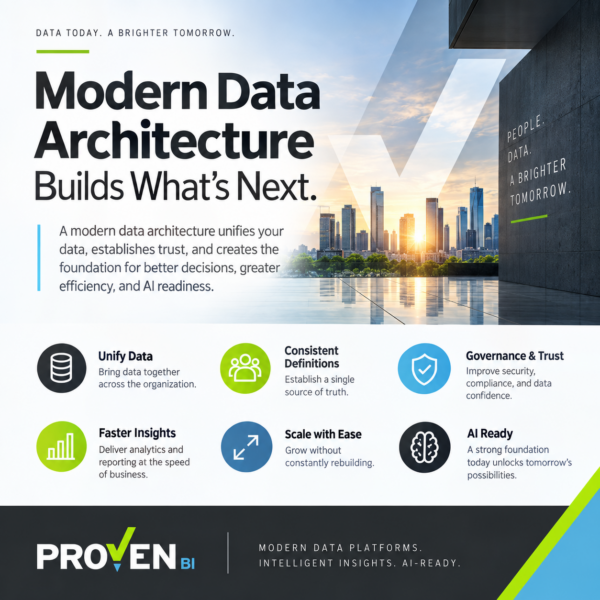
The Data Lakehouse has emerged as the modern architecture for organizations that need to support analytics, AI, governance, and future growth from a single platform.
Rather than maintaining separate environments for data lakes, warehouses, machine learning, and analytics, a Lakehouse brings everything together.
A modern Lakehouse typically organizes data into three logical layers:
Bronze Layer – Raw data collected from enterprise systems
Silver Layer – Cleansed, standardized, and validated data
Gold Layer – Business-ready data models optimized for reporting, analytics, and AI
This layered approach creates a governed, scalable foundation that supports multiple workloads without requiring multiple copies of the same data.
Why Organizations Are Moving Toward Lakehouse Architecture
The move to a Lakehouse isn’t simply about adopting new technology.
It’s about creating a platform that can evolve with the business.
One Platform for Analytics and AI
Instead of separate environments for reporting, machine learning, streaming data, and advanced analytics, organizations can support all of these workloads from a unified data foundation.
The result is less duplication, fewer integrations, and significantly lower operational complexity.
Better Governance from the Beginning
Modern Lakehouse platforms include governance as a core architectural component.
Organizations gain:
- Centralized metadata
- Data lineage
- Security policies
- Role-based access
- Data quality monitoring
- Business definitions
This improves trust across the organization while making regulatory compliance easier to manage.
Scalability Without Constant Re-Architecture
One of the biggest advantages of a Lakehouse is flexibility.
Storage and compute scale independently, allowing organizations to manage growing data volumes without redesigning the platform every few years.
Whether processing gigabytes or petabytes, the architecture remains consistent.
Faster Innovation
When data engineers spend less time moving and transforming data between platforms, they spend more time creating business value.
New data sources can be onboarded more quickly.
New dashboards are delivered faster.
AI initiatives move from proof of concept to production sooner.
Why This Matters for AI
There is no shortage of excitement around artificial intelligence.
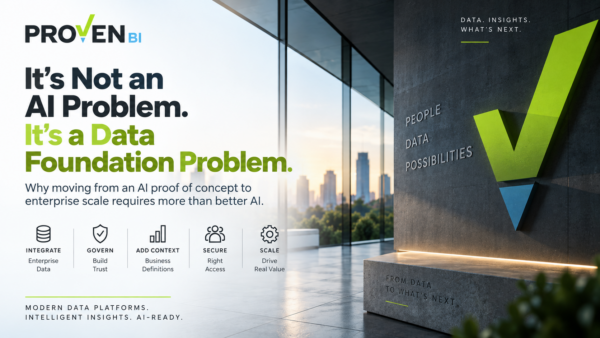
But organizations often focus on the AI tools before addressing the data foundation underneath them.
AI is only as effective as the data it can access.
If data is inconsistent, duplicated, incomplete, or poorly governed, AI produces unreliable results.
Organizations investing in modern Lakehouse architectures are building something much more valuable than an analytics platform.
They’re building an AI-ready foundation.
Looking Ahead
The conversation is no longer about replacing a data warehouse.
It’s about modernizing the entire data ecosystem.
Organizations need architectures capable of supporting analytics, operational reporting, streaming data, machine learning, and AI—all from a single, trusted foundation.
That’s exactly what the Data Lakehouse delivers.
The companies that invest in modern data architecture today will be the organizations best positioned to innovate tomorrow.
Final Thoughts
Modernization isn’t about chasing the latest technology trend.
It’s about building an architecture that can support where your business is headed—not where it has been.
If your organization is still relying solely on a traditional data warehouse, now is the time to evaluate whether your current architecture is prepared for the next generation of analytics, automation, and AI.
The future belongs to organizations with trusted, governed, and scalable data foundations.
The Data Lakehouse is helping make that future possible.