For many organizations, the data environment has become increasingly complex.
Years of adding new applications, databases, pipelines, reporting tools, and cloud services have created environments that are difficult to manage, expensive to maintain, and challenging to scale.
At the same time, business expectations are changing. Leaders want faster insights, better access to trusted data, more automation, and the ability to take advantage of AI.
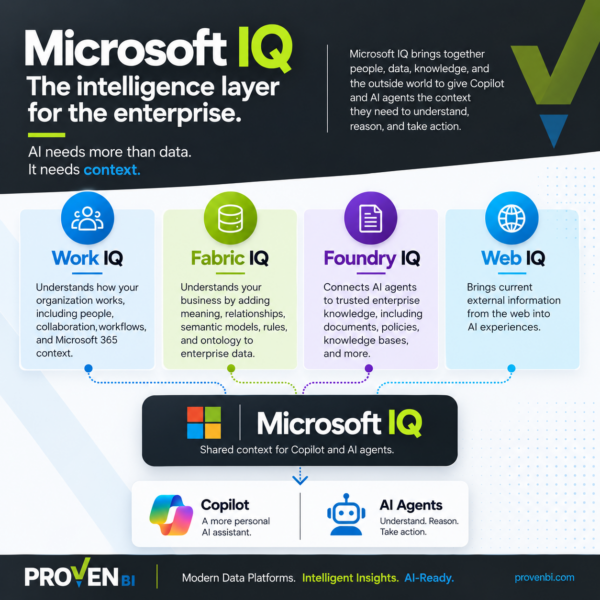
That is why more organizations are evaluating Microsoft Fabric as part of their data modernization strategy.
But migrating to Fabric should be about more than moving existing workloads to a new platform.
It should be an opportunity to modernize the architecture underneath them.
Why Microsoft Fabric?
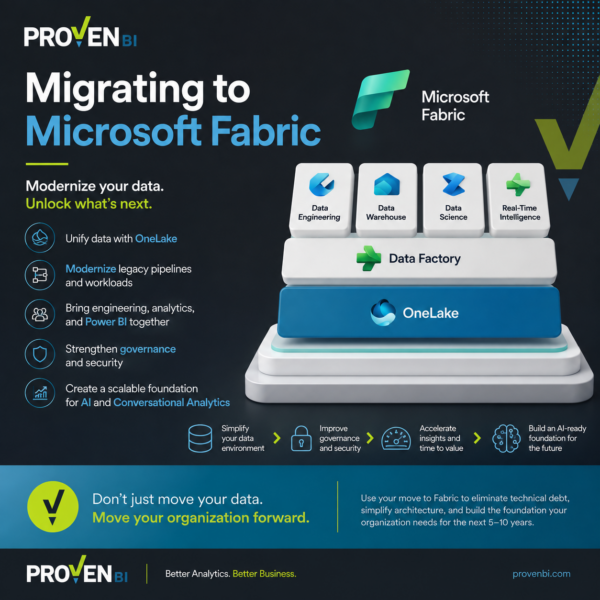
Microsoft Fabric brings many of the capabilities traditionally spread across multiple technologies into a unified data and analytics platform.
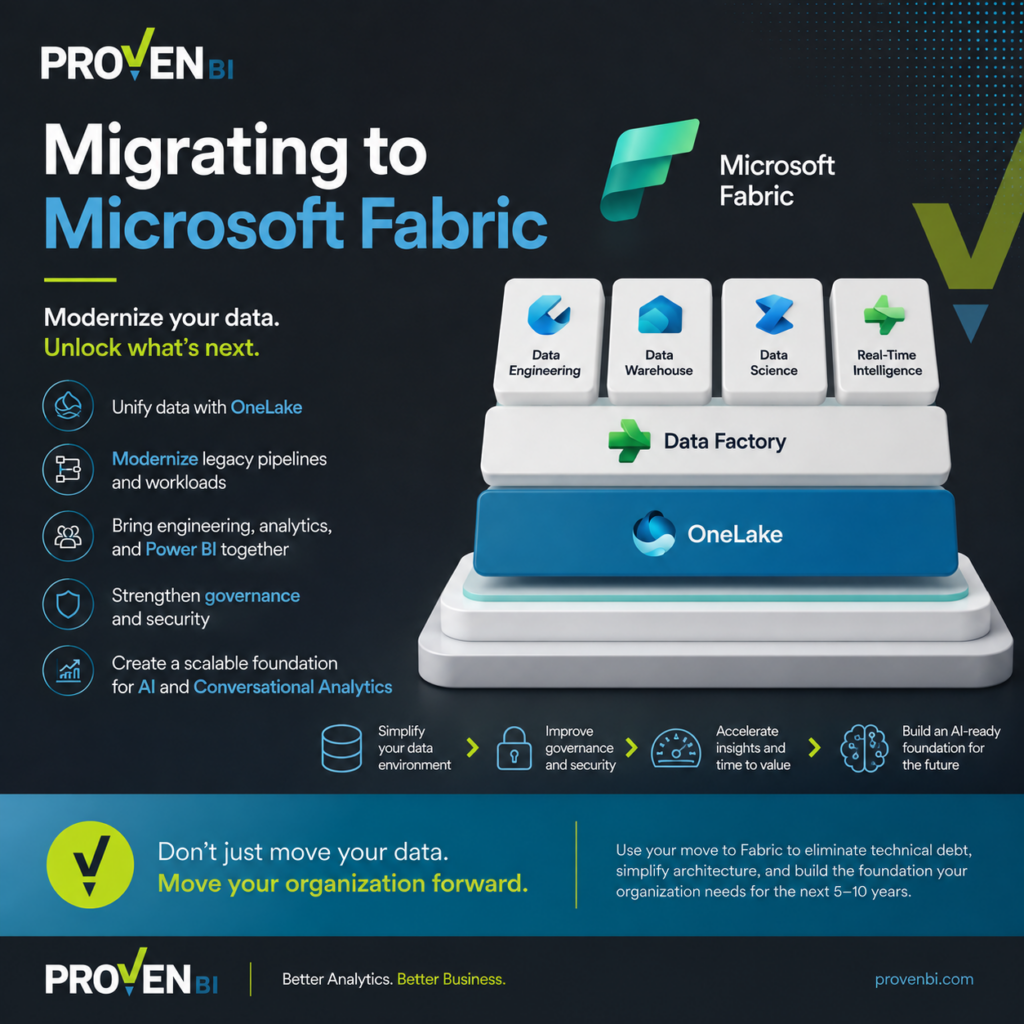
With Fabric, organizations can bring together data integration, engineering, warehousing, real-time intelligence, analytics, and Power BI while leveraging OneLake as a common data foundation.
For organizations already invested in the Microsoft ecosystem, this creates an opportunity to simplify the data environment while building a platform designed for analytics and AI.
The potential benefits include:
- Simplified architecture with fewer disconnected technologies
- Unified enterprise data through OneLake
- Modernized data pipelines and transformation processes
- Closer integration between data engineering, analytics, and Power BI
- Improved governance, security, and access controls
- A scalable foundation for AI and Conversational Analytics
But realizing those benefits requires more than simply migrating what exists today.
Don’t Rebuild Your Legacy Architecture in Fabric
One of the biggest mistakes organizations can make during modernization is recreating their existing environment on a new technology stack.
If your current architecture contains duplicated data, inefficient pipelines, inconsistent business logic, siloed reporting environments, or years of technical debt, moving those same problems into Fabric doesn’t solve them.
It simply gives you modern technology supporting an outdated architecture.
Instead, migration should begin by asking:
What should our data architecture look like if we were designing it for the business we need to support today and tomorrow?
That changes the conversation from a technology migration to a data modernization initiative.
A Better Approach to Fabric Migration
A successful Fabric migration should evaluate more than where workloads will move.
1. Assess the Current Environment
Start by understanding what you have today.
Inventory your data sources, databases, pipelines, transformations, reporting platforms, integrations, security models, and critical business processes.
More importantly, identify the pain points.
Where is data duplicated? Which pipelines are fragile? Where is business logic buried inside reports? Which processes are slow or manual? Where are users struggling to trust the data?
Understanding the current state provides the foundation for designing the future state.
2. Design the Future-State Architecture
Before migrating workloads, establish the architecture you want to build.
That includes decisions around:
- OneLake architecture
- Lakehouse and warehouse strategy
- Data ingestion and transformation
- Medallion architecture and data layers
- Semantic models
- Power BI architecture
- Security and access controls
- Data governance
- Metadata and lineage
- Development, testing, and production environments
The goal should be a platform that is scalable, governed, maintainable, and aligned with business needs.
3. Prioritize What Should Move
Not every legacy workload should automatically be migrated.
Some pipelines may need to be redesigned. Some reports may no longer provide value. Multiple datasets may be candidates for consolidation. Existing processes may be replaced entirely by capabilities available within Fabric.
Migration provides an opportunity to reduce technical debt rather than carry it forward.
4. Establish Governance from the Beginning
Governance shouldn’t be something added after the migration is complete.
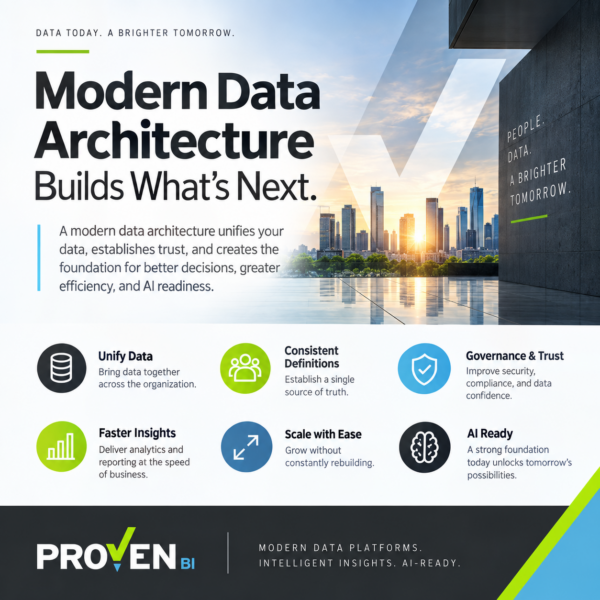
A modern data platform should establish clear ownership, security, lineage, business definitions, and access controls as part of the architecture itself.
This becomes even more important as organizations begin introducing AI.
AI systems need trusted, governed enterprise data if they are going to produce reliable business answers.
5. Build for AI From Day One
Organizations don’t need to deploy every AI use case immediately.
But they should build the platform so they are ready when those opportunities emerge.
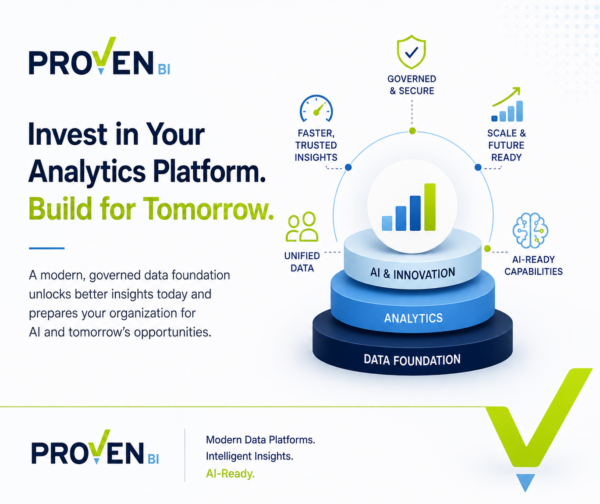
A properly architected Fabric environment can provide the governed data foundation needed to support advanced analytics, automation, machine learning, Microsoft Copilot, and Conversational AI.
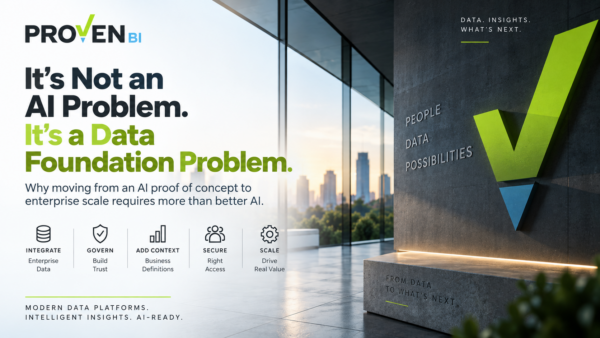
AI readiness doesn’t start with AI. It starts with the data foundation.
Fabric Migration Is a Business Opportunity
The most successful Fabric migrations shouldn’t be measured only by how many databases, pipelines, or reports were moved.
They should be measured by what became possible afterward.
Can users access trusted information faster?
Can the organization develop new analytics capabilities more quickly?
Has the architecture become easier to maintain?
Has technical debt been reduced?
Is governance stronger?
Can the organization introduce new AI capabilities without rebuilding its data foundation again?
Those are the outcomes that ultimately matter.
How ProvenBI Helps Organizations Migrate to Microsoft Fabric
At ProvenBI, we help organizations evaluate, architect, and implement modern data platforms designed for analytics and AI.
Our approach begins with the foundation.
We work with organizations to assess their existing environment, identify technical debt and architectural gaps, design the future-state architecture, and develop a practical roadmap for moving to Microsoft Fabric.
Depending on where an organization is in its journey, that can include:
- Current-state architecture assessments
- Fabric readiness and migration planning
- Future-state architecture design
- OneLake and Lakehouse architecture
- Data pipeline modernization
- Data warehouse modernization
- Power BI and semantic model strategy
- Governance and security architecture
- Fabric implementation and workload migration
- AI and Conversational Analytics readiness
The objective isn’t simply to move your data.
It’s to create a modern, trusted data foundation that can support the organization for years to come.
Modernize the Architecture, Not Just the Technology
Microsoft Fabric represents a significant opportunity for organizations to simplify their data environments and prepare for the next generation of analytics and AI.
But the technology alone won’t create that transformation.
Architecture matters. Governance matters. Data quality matters.
The decisions made during migration will determine whether Fabric becomes another technology platform or the foundation for how your organization uses data going forward.
Don’t just move your data.
Move your organization forward.
Ready to Evaluate Your Fabric Strategy?
If your organization is considering Microsoft Fabric, ProvenBI can help assess your current environment, define the future-state architecture, and identify the right migration path.
Modern Data Platforms. Intelligent Insights. AI-Ready.
Contact ProvenBI to start the conversation.