Executive Summary
The modern data platform conversation has evolved rapidly over the past few years. What began as a race to adopt cloud technologies, data lakes, and visualization tools has now shifted into a more mature and pragmatic phase. In 2026, organizations are no longer asking what tools should we use, they are asking why they are not getting value from the data they already have.
The answer is increasingly clear: most data challenges are not technology problems, they are architecture, governance, and alignment problems.
This white paper outlines what actually matters in a modern data platform today. It moves beyond hype and tooling discussions to focus on the foundational elements required to support analytics, automation, and AI at scale.
The Shift: From Tools to Architecture
Over the past decade, enterprises have heavily invested in best-of-breed tools across data engineering, warehousing, business intelligence, and now AI. Platforms have become more powerful and more unified, reducing the friction of integration and accelerating time to deployment.
Yet despite these advancements, many organizations still face the same persistent challenges. Conflicting metrics across departments, business logic embedded in reports instead of centralized systems, siloed data sources with inconsistent definitions, limited trust in analytics outputs, and difficulty operationalizing AI initiatives.
These issues are not caused by a lack of technology. They are the result of fragmented architecture and the absence of a governed, scalable data foundation.
In 2026, successful organizations are shifting their focus from what tools they use to how their data is structured, governed, and delivered across the enterprise.
Core Principle: AI Readiness Starts with Data Foundations
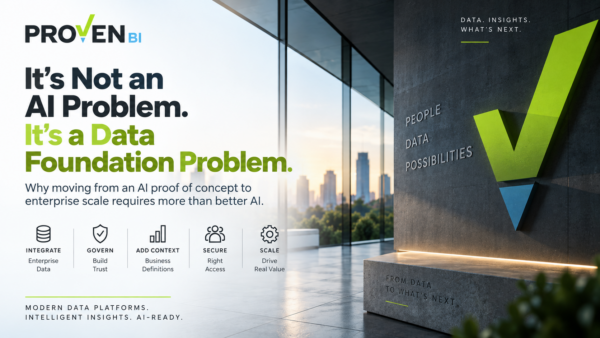
There is significant pressure across industries to adopt AI and advanced analytics. However, organizations attempting to layer AI on top of fragmented and ungoverned data environments consistently fail to realize meaningful value.
AI is not a starting point. It is an outcome.
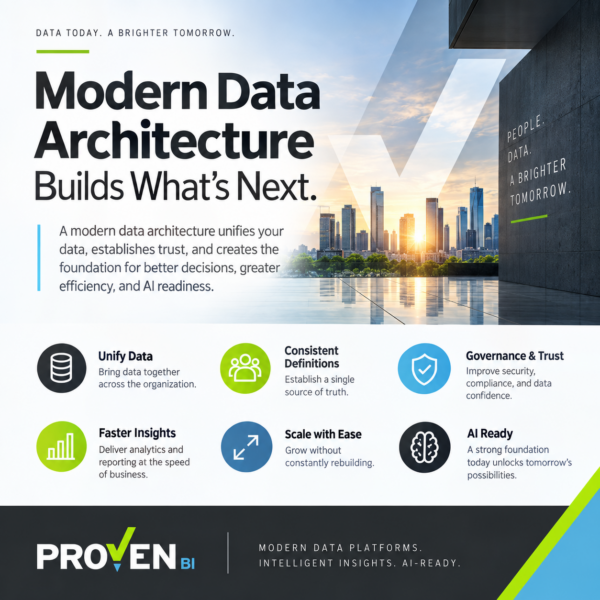
A modern data platform must first ensure that data is unified across systems, business definitions are standardized, data quality is measurable and trusted, and governance is embedded, not bolted on.
Only then can organizations effectively scale analytics and AI use cases.
What Actually Matters in 2026
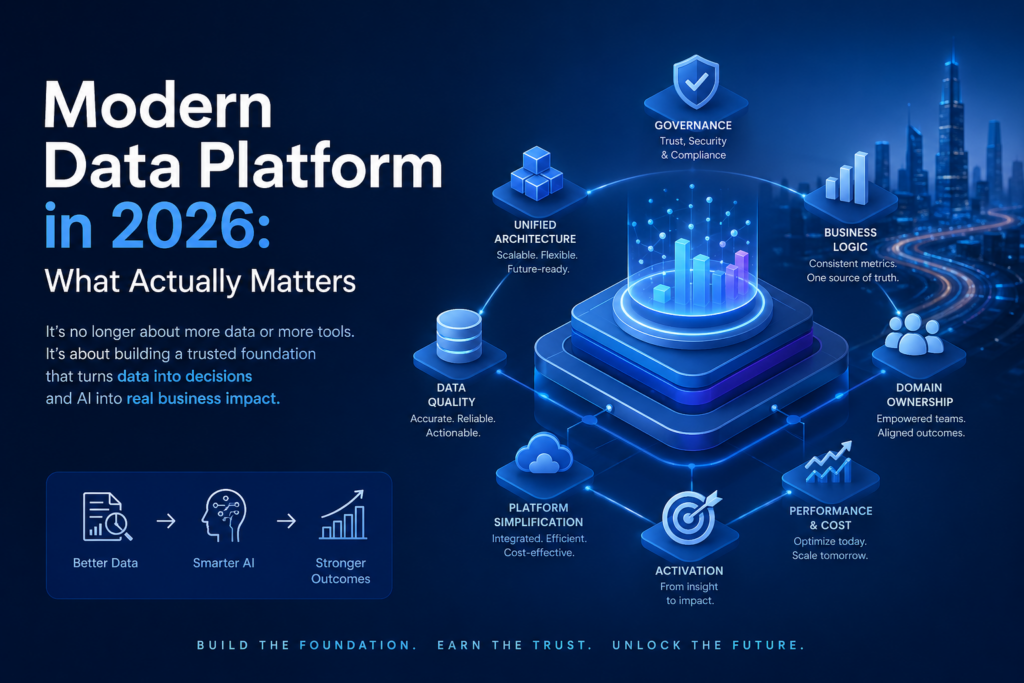
Unified Data Architecture
A modern data platform must consolidate data across disparate systems into a centralized, scalable architecture. This does not mean physically moving all data into a single system, but rather creating a unified layer where data can be accessed, governed, and understood consistently.
Key characteristics include standardized ingestion and processing patterns, clear separation of raw, refined, and curated data layers, scalable storage and compute aligned to workload needs, and support for both batch and real-time data processing.
The goal is not just consolidation, it is coherence.
Centralized Business Logic
One of the most common failure points in data platforms is the duplication of business logic across reports and tools. When each dashboard defines metrics differently, trust erodes and decision-making suffers.
In 2026, leading organizations are defining business logic once in governed data layers, removing transformations from BI tools and embedding them upstream, and creating reusable semantic models aligned to business domains.
This approach ensures that every report, model, and AI system is built on the same foundation of truth.
Governance as a Core Capability
Governance is no longer a compliance exercise, it is a business enabler.
Modern platforms embed governance directly into the architecture through data catalogs and lineage tracking, clear data ownership and stewardship models, role-based access controls and security frameworks, and continuous monitoring of data quality and usage.
Organizations that treat governance as an afterthought struggle to scale. Those that operationalize governance unlock trust, adoption, and long-term value.
Data Products and Domain Ownership
The shift toward data products and domain-oriented ownership models continues to gain traction. Rather than central teams acting as bottlenecks, business domains take ownership of their data assets while adhering to enterprise standards.
This model enables faster delivery of analytics capabilities, improved alignment between data and business outcomes, and scalable ownership without sacrificing governance.
However, this only works when supported by a strong centralized architecture and shared governance framework.
Platform Simplification and Consolidation
The proliferation of tools has created unnecessary complexity across many organizations. In response, there is a growing movement toward platform consolidation, not to limit flexibility, but to reduce friction and improve integration.
Modern platforms in 2026 emphasize end-to-end capabilities within unified ecosystems, reduced data movement between systems, simplified operational management, and lower total cost of ownership.
The objective is not fewer tools for the sake of simplicity, but fewer disconnected tools.
Performance, Scalability, and Cost Control
As data volumes grow and AI workloads increase, performance and cost management become critical.
Organizations are prioritizing elastic compute models that scale with demand, efficient data storage strategies, observability across pipelines and workloads, and proactive cost optimization practices.
A modern data platform must balance performance with financial sustainability.
Activation: Turning Data into Decisions
Ultimately, the success of a data platform is measured by its ability to drive decisions and outcomes.
This requires seamless integration with business applications, real-time or near-real-time data availability, embedded analytics within operational workflows, and clear pathways from insight to action.
Data that sits in dashboards without influencing behavior delivers limited value.
Common Pitfalls to Avoid
Even with the right intentions, organizations often fall into familiar traps. Over-prioritizing tools over architecture, attempting to implement AI before establishing data foundations, allowing business logic to remain fragmented across reports, underestimating the importance of governance, and failing to align data initiatives with business outcomes.
Avoiding these pitfalls requires discipline, clarity of vision, and a structured approach to platform development.
A Structured Approach to Building a Modern Data Platform
Organizations that succeed in 2026 follow a phased and intentional approach.
First, foundation, establishing unified architecture, ingestion patterns, and governance frameworks.
Second, standardization, defining business logic, data models, and semantic layers.
Third, enablement, delivering self-service analytics and domain-level data ownership.
Fourth, optimization, improving performance, cost efficiency, and operational reliability.
Fifth, activation and AI, scaling advanced analytics, automation, and AI use cases.
This progression ensures that each layer builds on a stable and trusted foundation.
The Bottom Line
The definition of a modern data platform has matured. It is no longer about adopting the latest technology or building the most complex architecture.
What actually matters in 2026 is far more practical. A unified and scalable data foundation, centralized and trusted business logic, embedded governance and ownership, simplified and integrated platforms, and a clear path from data to decisions.
Organizations that focus on these principles are not only improving analytics, they are positioning themselves to fully realize the promise of AI.
Those that do not will continue to struggle, regardless of the tools they adopt.
Closing Perspective
The future of data is not about more data, more tools, or more complexity. It is about clarity, alignment, and execution.
A modern data platform is not built overnight, nor is it defined by a single technology. It is the result of deliberate architectural decisions, strong governance, and a commitment to building a foundation that can support the next generation of analytics and AI.
In 2026, the organizations that win are not the ones chasing innovation, they are the ones building it on the right foundation.